Practical Ways to Fling Your Cares on the Lord
Last week, by the help of the Holy Spirit, we were equipped with a lifetime secret to living a burden-free and anxiety-free life, anchored on 1 Peter 5:7 (AMP): “Casting all your cares [all your anxieties, all your worries, and all your concerns, once and for all] on Him, for He cares about you [with deepest affection, and watches over you very carefully].” We examined the word “cast,” from the Hebrew word shalak, which means to throw, to hurl, or to fling with force. We were encouraged to fling our worries suddenly, forcefully, and without hesitation and not to carry them gradually, but to release them completely into God’s able hands.
This week, we look at practical ways to continually fling our cares onto the Lord and remain free:
1. See the End from the Beginning
No matter what life presents at any given time, focus not on the events unfolding before you but on the guaranteed outcome. The Word of God assures us that victory is the final result for everyone born of God and the Lord Himself commands us in John 16:33 - “These things I have spoken unto you, that in Me you might have peace. In the world you will have tribulation; but be of good cheer, I have overcome the world.” In John 5:4, the Bible further declares - “For whatsoever is born of God overcomes the world: and this is the victory that overcomes the world, even our faith.”
This assurance empowers us to fling all our cares onto the Lord, knowing that because we are born of God, we are destined to overcome. Therefore, when worry arises concerning any area of life, remember, you are already standing at an advantage and victory is your inheritance. If you knew that the outcome is victory, why worry?
2. Prayer and Thanksgiving
One common response when worry appears is to complain or speak to everyone else about it before speaking to God. Yet prayer is God’s prescribed pathway to absolute freedom from anxiety. This is a natural response; we are always keen to share our burden with people. Even I have inadvertently followed this pattern. Thankfully, at a certain point in my life, the Holy Spirit instructed me not to discuss my challenges with anyone until I first spoke to Him about them. Even when I later shared with others, it had to come from a place of faith and not anxiety. That instruction became a true game changer for me.
Moreso, the Bible gives us a simple but powerful formula in Philippians 4:6 - “Be anxious for nothing, but in everything by prayer and supplication, with thanksgiving, let your requests be made known unto God.” Prayer combined with thanksgiving does two powerful things: i.) it invites divine intervention into every situation that you pray about and ii.) it transforms your inner posture from worrying to gratitude. You cannot remain thankful and worried at the same time. Thanksgiving shifts the heart from fear to gratitude and from anxiety to joy.
2 Corinthians 2:14 reminds us - “Now thanks be unto God, which always causes us to triumph in Christ.” When you thank God, you affirm your confidence that He will cause you to triumph. Worry, on the other hand subtly casts doubt on God’s capacity. Thanksgiving is therefore an act of faith and a declaration that victory is already secured.
3. Take God’s Yoke in Exchange for Your Worries
Our Lord Jesus gave clear instructions concerning worry in Matthew 6 and listed things we as the children of God should not be anxious about, from what to eat, what to wear to daily necessities. These are concerns that dominate the thinking of unbelievers. Instead, the Lord redirects our focus in Matthew 6:33 - “But seek first the kingdom of God and His righteousness, and all these things shall be added unto you.”
This a clarion invite from our Heavenly father into a divine exchange, to wit; we release our burdens, and we take up His priorities. When we focus on kingdom matters, praying for souls, advancing God’s purposes, and aligning with His will on earth. In response, God assumes responsibility for our personal concerns and His yoke replaces our worries. As we carry what matters to God, He carries what concerns us.
Conclusion
Living free from worry is a sign of total obedience to God’s instruction and not necessarily a denial of life’s challenges. Each day presents an opportunity to fling our cares onto the Lord decisively, completely, and in faith, knowing and trusting fully in His loving care. I pray that the Lord will give us all the grace to trust Him more and worry less in Jesus name?
Remain ever blessed!
Author: Loveth Okocha

The Secret to a Burden-Free Year/Life
In the lead up of the last year, whilst packing up to leave the office, a recurring thought found its way into my mind with the intention of taking over my entire thought process that evening. Somehow, by the help of the Holy Spirit, I muttered out loud: “These are the sorts of issues unbelievers should worry about; it’s not my headache.” Mathew 6:32. I immediately followed that thought with another declaration: “but not you Loveth, mine is to seek the kingdom of God first; His is to add these things to me.” Matthew 6:33. As soon as I said this, my colleagues looked around to see who I was speaking to, but at that moment, I couldn’t be bothered because I knew I had just managed to silence worry and anxiety for that season.
The Human Tendency to Worry
As humans, we cannot help but worry. We worry about: what to eat; what to wear; where to live; who to marry; where to work; who to allow access into our lives and the list is endless. However, the danger of worrying, according to the Word of God, is clearly stated by Jesus Himself in Matthew 6:27 (AMP): “And who of you by worrying can add one cubit to his stature?”
A cubit was a unit of measurement (about 18 inches) and in this verse, Jesus was simply saying that worry is powerless, it cannot increase your height, extend your life, improve your situation, or produce solutions, rather, worry expends energy but adds no real benefit to the situation.
One Scripture for a Burden-Free Year/Life
This week, I’m sharing a simple yet profound hack to living a burden-free, anxiety-free, and worry-free year/life all from 1 Peter 5:7 (AMP): “Casting all your cares [all your anxieties, all your worries, and all your concerns, once and for all] on Him, for He cares about you [with deepest affection, and watches over you very carefully].” As we continue setting the pace for this year, the most favorable and powerful thing you can do for yourself is to cast your cares on the Lord.
The word “cast” comes from the Hebrew word “shalak”, which means: to throw, to hurl, to fling with force. Biblically, it is used in the context of casting away, down or forth. A similar instruction is repeated by the Psalmist in Psalm 55:22. One substitute word I particularly love from this term is “fling,” (we used that a lot in High School). To fling means to throw something suddenly, forcefully, and without hesitation. This tells us something important, casting your cares is an intentional, forceful, and decisive step towards getting rid of it. To cast all your burdens, anxieties, worries, and concerns on the Lord once and for all means to violently throw them onto God without over-processing them and by implication, transferring ownership to Him.
The Spiritual Shift That Happens
The moment you cast your cares on the Lord, the dynamics immediately change. The weight you were never designed to carry shifts from you to God. “Cast your burden on the Lord, and He will sustain you.” Psalm 55:22. When you cast something onto God, you hurl it with such force that you intentionally create distance between yourself and the burden.
In contrast, when you carry your burdens, they oppress you and weigh you down, turning a concern into worry and worry, when it is magnified grows when it is repeatedly meditated upon, thereby placing the problem above God. At that point, the problem becomes the focus of your devotion rather than God.
Replacing the Burden: God’s Yoke
Nature does not allow a vacuum, once you have successfully flung your burdens onto the Lord, you must then take on God’s yoke to occupy the vacuum you have created by hurling all your burdens on the Lord. Our Lord Jesus says: “Come to Me, all who are weary and heavily burdened, and I will give you rest. Take My yoke upon you and learn from Me…For My yoke is easy [useful, manageable], and My burden is light.” Matthew 11:28–30 (AMP).
In exchange for your heavy and unbearable burdens, yokes, cares and concerns, the Lord offers you an opportunity to exchange them for his manageable and useful burden, which is light by the way. But it doesn’t end here, when you exchange your burdens for God’s yoke: you find rest for your soul, as long as you don't take your yoke back.
Conclusion
Casting your cares on the Lord is a sign of trust and an acknowledgment that God is better equipped to handle what overwhelms you. Some may consider this as living in denial and unwise, but in the context of spiritual wisdom, it is actually one of the smartest moves you can make for your all round well being. Each time you consciously fling your cares onto the Lord, you reaffirm who is in control of your life.
As you journey through this year and beyond, I pray that your heart will remain anchored on the Lord, knowing that the God who cares for you is faithfully carrying everything you laid at His feet. In the next part of this article, I’ll be sharing practical ways to fling your cares onto the Lord and remain free.
Remain ever blessed.
Author: Loveth Okocha

Seven Practical Action Points for Maximizing 2026
As we continue our journey through the year 2026, it is vital for us to align with the vision God has set before us because sustaining momentum throughout the year requires more than human willpower; it demands a deep reliance on the mercy, grace, and faithfulness of God. The Word of God is clear on this in Philippians 2:13: “it is God which worketh in you both to will and to do of his good pleasure”.
Outlined below are seven key action points I managed to put together to help you maximize the opportunities, growth, and impact available to you in 2026. Each step is grounded in biblical truth and practical wisdom, ensuring that your progress is both purposeful and Spirit-led. Please bear in mind that the list is not exhaustive, thus, spiritual sensitive to what the Lord is emphasizing to you per time through His spirit should always be prioritized over the steps in discuss.
1. Set Clear and Comprehensive Goals
Take time to set clear, written goals that touch every major area of life, including: your career and professional development; your prayer and Word study; your kingdom advancement and giving; your health and wellness and investment and financial stewardship, etc. Intentional living begins with clarity, So, the clearer your vision, the better positioned you’d be to actualizing them.
Most of us are familiar with Habakkuk 2:2: “Write the vision, and make it plain upon tables, that he may run that readeth it”, but very few persons take the time to actually put their vision and plans down. As simple as this instruction may seem, writing down your plans is one of the most powerful but underrated habits towards clarity. A vision that is written becomes a vision that is actionable.
Beyond Scriptures, studies have shown that writing down goals significantly increases the likelihood of achieving them as clearly defined objectives could enhance your focus, accountability, and consistency. Spiritually, writing your visions down also serves as a reminder of God’s direction when your motivation begins to wane. Proverbs 16:3: “Commit thy works unto the LORD, and thy thoughts shall be established.”
2. Examine Yourself and Make Necessary Adjustments
Regularly assessing your habits, attitudes and outcomes helps identify areas of self-sabotage and reveals approaches that need to be refined or abandoned. This is helpful for not just the beginning of the year but for every now and again. Moreso, progress requires honest self-examination as Apostle Paul admonishes in 2 Corinthians 13:5: “Examine yourselves, whether ye be in the faith; prove your own selves.”
Self-examination creates room for repentance, growth, and constant re-alignment with God’s will for your life. Self-examination is also a sign of humility, invariably attracting God’s grace and just like the Bible says, God “gives more grace to the humble.” See also Psalm 139:23 “Search me, O God, and know my heart: try me, and know my thoughts.”
3. Let Go of What Holds You Back
To move forward in 2026, you must let what belongs to the past stay right there. When I speak of the past, I don’t just mean the bad things that happened to you, rather, the past includes former failures, disappointments, offenses, and past successes that may hinder your fresh dependence on God. Forgiveness and spiritual detachment are essential keys to moving forward.
Paul captures this posture in Philippians 3:13: “Forgetting those things which are behind, and reaching forth unto those things which are before.” God often does a new thing, but it requires us to let go of the old. This is also corroborated in Isaiah 43:18–19: “Remember ye not the former things, neither consider the things of old. Behold, I will do a new thing.”
4. Create an Accountability System
Growth thrives in healthy relationships. In 2026, intentionally surround yourself with people of faith and vision who can walk with you: prayer partners, mentors, coaches, and spiritually mature friends. With accountability comes correction, encouragement and stability. According to Proverbs 27:17 “Iron sharpeneth iron; so, a man sharpeneth the countenance of his friend.”
The Bible also emphasizes the dangers of isolation in Ecclesiastes 4:9–10 whilst outlining the benefits of partnership which amongst others could potentially multiply your strength and reward. See Proverbs 13:20: “He that walketh with wise men shall be wise.”
5. Reflect and Represent Jesus More Effectively
One of the highest goals you can set for yourself in 2026 and even for life is aiming to reflect Christ through your lifestyle (in character, conduct and compassion). This means intentionally cultivating the fruit of the Spirit and striving to respond to situations as Jesus would.
Unbelievers may never read the Bible, but they read our lives daily. As noted by Apostle Paul in 2 Corinthians 3:2-3: “Ye are our epistle… known and read of all men… written not with ink, but with the Spirit of the living God.” Read Matthew 5:16 and Galatians 5:22–23 respectively: “Let your light so shine before men, that they may see your good works, and glorify your Father which is in heaven.” “But the fruit of the Spirit is love, joy, peace, longsuffering, gentleness, goodness, faith…”
6. Plan to Obey God’s Instructions Fully
If you want to walk in victory throughout 2026, you must be willing to obey the Lord fully, not partially or by just cherry picking some parts of the Bible that is suitable for you to obey. Please bear in mind that God speaks directly to us His children through His Word and the Holy Spirit, but in addition, He speaks through divinely appointed leadership.
Therefore, you should aim to honour divine instructions that God gives you either directly or through your spiritual leaders. In 2 Chronicles 20:20, the Lord commends us to “Believe in the LORD your God, so shall ye be established; believe his prophets, so shall ye prosper.” See also Hebrews 13:17: “Obey them that have the rule over you, and submit yourselves: for they watch for your souls.”
7. Invest Deeply in Prayer
Prayer is the foundational secret to accomplish all that you’d desire for the year 2026 and beyond. Therefore, in 2026, make prayer a lifestyle. The secret is to pray without ceasing, pray alone, pray in private, pray with people, pray in public, pray quietly, pray aloud, pray in the Spirit, pray with understanding, pray when you have all the clarity, pray when confusion abounds, by all means, just keep praying.
One thing is certain; you could never over pray. See 1 Thessalonians 5:17: “Pray without ceasing.” One of the greatest benefits of prayer is that it keeps the heart sensitive and the spirit man alert at all times. This in turn ensures that you are aligned with God’s plan for your life per time. See also Luke 18:1 and Matthew 26:41 respectively: “Men ought always to pray, and not to faint” and “Watch and pray, that ye enter not into temptation.”
Conclusion
As you engage he various steps above, I congratulate you in advance on the beautiful year ahead and I pray that in 2026, God will grant you the grace to achieve and surpass your targets, expectations, and righteous desires in the order of Ephesians 3:20: “Now unto him that is able to do exceeding abundantly above all that we ask or think, according to the power that worketh in us.”
Remain ever blessed!
Author: Loveth Okocha
Happy New Year: The Gift of a New Beginning
It is a truism that the start of each year offers us a sense of renewal, a reset button of sorts. We feel inspired to pick up habits we once abandoned, to revisit goals left unfinished, and to recommit to ideals that are deeply important to us. I don’t know about you, but for me, there is something undeniably energizing about a fresh start, new calendars, new plans and new possibilities. What is far less clear, however, is how to sustain that momentum beyond the opening weeks of the year or at least long enough to achieve the goals we so passionately set.
Record-high studies consistently show that while most people begin the year with enthusiasm and resolve, many experience a relapse before the end of January as those goals get abandoned, the routines disrupted, and perhaps most painfully, people often feel worse than when they first began the year. This pattern is familiar to many of us and happens even to the best of us.
From a personal standpoint, I recall always having a strong urge to “start from the very beginning” each time I failed to follow through with my plans, as though failure disqualified me from continuing. Somehow, I believe starting from the very beginning was enough retribution for my failures in the first instance. But in one such moment of reflection, I stumbled upon a powerful truth in the book of Lamentations, a verse that I have always known but this time, it turned to a liberating truth that reframed my entire perspective on failure, progress, and grace: “It is of the LORD’S mercies that we are not consumed, because his compassions fail not. They are new every morning: great is thy faithfulness.” Lamentations 3:22–23 (KJV).
These verses reveal something profound about God’s character and His understanding of our human limitation. God, in His magnificent mercy, knew that even the best of us cannot sustain perfection, no matter how hard we try. And so, He designed life not as one long, unbroken stretch, but in days. Each day carries within it the opportunity to begin again., not just a yearly start. Even more importantly, with every new day, God releases the required dose of grace needed to carry us through that day.
We are not given grace in bulk for a lifetime; instead, we are given grace daily, precisely measured for our present need. So what does this mean for you and me as this year begins? It is really quite simple. Rather than being overwhelmed by the enormity of an entire year, I invite you to take advantage of the daily mercy God makes available to us. You don’t have to wait for dramatic progress to count it as meaningful. Rather, view the faithfulness of today better than perfection over twelve months. One day at a time, you can push our goals forward, anchored in God’s mercies and faithfulness toward you.
In other words, you don’t need to wait for another lap around the sun, a new month nor a new week before you can start again. God’s mercy is always fresh toward you. While God Himself has not changed nor added to His mercies, our perception and experience of them must be continually renewed daily. Every morning offers an opportunity for a “mini reset,” a chance to lay hold of grace afresh and move forward without the weight of yesterday’s failures. Proverbs 24:16 is profound – “For a righteous man may fall seven times And rise again…”
There is also a quiet kindness in the fact that a day is only twenty-four hours long. God, in His wisdom, allows us to sleep, to put to bed our anxieties, our fears, and our unfinished business. If a day were much longer, we might at times find ourselves unable to bear the accumulated load. The close of a day brings a measure of relief, a sense of closure, even if only temporarily and with dawn comes new mercy.
As we continue this journey through the year, remembering this daily rhythm of grace can change how we approach our goals, our failures, and ourselves. Stay focused, knowing that God releases the required dose of grace to carry you through every phase in your life, including this year. Next week, we will explore practical ways to stay true to your vision for the year, grounded not just in willpower alone, but in the sustaining mercy and faithfulness of God.
Remain ever blessed and enjoy the best of 2026.
Author: Loveth Okocha

The Higher Truth: Rising Above Bad News
In the past week, I found myself ruminating deeply on Psalm 112:6–7, and I believe the Holy Spirit was gently trying to teach me something profound, something I felt strongly impressed to share. As children of God, we often ask that no form of bad news ever comes our way. And while that is a valid prayer point and a level of truth, the Word of God reveals a higher truth, which is: the righteous are not afraid of bad news; their hearts remain steadfast because their trust is rooted in the Lord. This is the posture of a believer who has matured beyond events and has anchored his or her heart in the unchanging nature of God.
“Surely the righteous will never be shaken; they will be remembered forever. They will have no fear of bad news; their hearts are steadfast, trusting in the Lord.” - Psalm 112:6–7 (NIV)
This is a truth I personally found confronting, because, up until the last few weeks, many times, while praying for people, I always declared boldly that they would never receive any bad news, which in itself is a level of light. But the Holy Spirit showed me that there is a higher light, just like the Bible says "God made the two great lights, the greater light to rule the day, and the lesser light to rule the night…” (Genesis 1:16). In this context, the lesser truth is that bad news may come; the greater truth is that the righteous do not fear it because their confidence is anchored in something bigger than circumstances: the Word of God.
You’d agree with me that the times we live in demand this level of spiritual strength to carry us through the gloomy days. The Bible is explicit that we are in days of shaking: “Yet once more I shake not the earth only, but also heaven.” (Hebrews 12:26). Economics shake, immigration systems shake, health systems shake, nations shake, but the one thing that never shakes is the Word of God. Because you and I are rooted in that Word, we too remain unmovable. "They that put their trust in the Lord are like mount Zion, which cannot be shaken but endures forever." (Psalm 125:1). This means that believers who trust God are unshakeable, steadfast, and enduring, just like Mount Zion, which is a strong, permanent hill in Jerusalem, symbolizing God's presence and protection, assuring us that we are surrounded by the Lord and cannot be moved by troubles.
That means there will be moments when bad news reaches you, news about your health, news concerning your immigration journey, news about your finances, career, marriage, or the future you desire. Even the systems you trusted may shift unexpectedly, creating delays or uncertainties and these are real facts. But as I always say, the realities of life, no matter how real, are facts, not the truth. And while facts describe your situation, the truth determines your outcome. The truth is anchored on the Word of God, and the Word of God is the ultimate reality of your life.
Doctors may give you a painful report; immigration rules may change in a way that seems to work against you; economies may present inflation that threatens your peace. But the real question is: what has God said? Which report will you believe? Like my spiritual father would always say, “It is not unscriptural to be challenged, but it is anti-covenant to be defeated.” The Bible confirms this: “Now thanks be unto God, which always causeth us to triumph in Christ…” 2 Corinthians 2:14 (KJV). Even in the face of the hardest news, God’s covenant assures us of victory. That means bad news, in the life of a believer, is simply a testimony waiting to be born.
You may feel pressed, but never crushed: “We are hard pressed on every side, but not crushed…” 2 Corinthians 4:8 (NIV). Even when it feels like God is allowing you to walk through something, remember what the Psalmist said: “The Lord disciplined me severely, but He has not given me over to death.” Psalm 118:18 (TPT). This is mine and your reality: God will never let the end of our story be defeat.
What do you do when bad news comes?
- Search out the Word of God concerning your situation: The first battle is always revelation. Once you know what God has said, juxtapose the fact to the truth. Will you respond like Joshua and Caleb who chose God’s report, or like the ten spies, who allowed the facts to drown out their faith? The promised land is still yours, but the question is: which lens will you use, the lens of fear or of faith?
- Make a resolve to let God’s Word be your reality: God has given us the power of choice. Choose the Word and let it define your identity, your expectations, and your future. Build convictions:
- “I am the Lord who heals you.” — Exodus 15:26
- “With long life I will satisfy him…” — Psalm 91:16
- “I know the plans I have for you… to give you a future and a hope.” — Jeremiah 29:11
Convictions turn Scripture from letters on a page into life-altering realities, popularly known as rhema.
- Thank God in the face of the news: Thanksgiving is the purest expression of faith. When you thank God before the testimony shows up, you are declaring in the spirit that the matter is already settled. This was Jesus’ posture at the tomb of Lazarus before the miracle, He gave thanks and Lazarus came forth (John 11:41). Thanksgiving shifts atmospheres and opens the door for resurrection power.
- Proclaim the Word boldly: You have the authority to speak light into darkness.
“You shall decree a thing, and it shall be established unto you, and the light shall shine upon your ways.” - Job 22:28. The “darkness” in this verse is the bad news whilst the light here is the Word of God. If darkness lingers, it is simply because light has not yet been released. Turn it on, speak the Word and declare the truth over any negative verdict.
Conclusion
You may not be able to control the news you receive, but you have full authority over how it shapes your heart. When your trust is truly anchored in God, fear loses its voice. This is where I apply what I call my personal litmus test from Romans 8:26–28: Do I love God? Am I called according to His purpose? The answer is yes, because Jesus Himself said in John 16:15 that everything the Father has belongs to Him, and by extension to us. And if I love Him and I am called, then all things must work together for my good. It is as plain and as powerful as that. If you can bring yourself to believe these words not just read them, not just quote them, but believe them you will never be afraid of anything again. Even bad news will lose its ability to intimidate you.
Stand firm and let your spirit remain anchored in the unshakeable Word of God. Bad news may come, but you will not be moved. You are a covenant child, destined to triumph always. And whatever confronts you is simply being rearranged by God to work together for your good. Your testimony is already in motion, and nothing, absolutely nothing will stop what God has ordained for you.
Remain blessed and know that you are an overcomer, no matter what comes your way.
Author: Loveth Okocha

The Weapons of Our Warfare Part 2: Enforcing Victory
As we established earlier, our battle is not against men and women with flesh and blood, not your uncle, your aunt, your boss, nor the so-called “village people.” Until a believer understands this truth, he or she will keep struggling like a blindfolded boxer, throwing punches into the air without landing a hit on the real enemy. Incidentally, Apostle Paul admonishes against this sort of fight in 1 Corinthians 9:26 NIV: “…I do not fight like a boxer beating the air.”
The above goes to say that there is always a strongman behind every negative situation, and until that strongman is identified and bound, the surface issues will persist. This is clearly explained by our Lord Jesus Christ in Matthew 12:29 to the effect that no one can enter a strong man’s house and spoil his goods unless he first binds the strong man. More often than not, once the real adversary is confronted, you will often find that the human face you thought was the cause of your trouble had no power of their own but was merely a tool the enemy exploited.
How Did I get into this Battle?
Someone once said to me, “Why me sis Love?” when faced with trials and attacks, not realizing that she has been conscripted in a spiritual army. My illustration to her was this, just as a citizen of Ukraine did not need to declare personal enmity with Russia to be affected by their national conflict, a believer’s identity alone places him at odds with the devil. As you may already know, two invisible kingdoms exist and they are constantly in contention, the kingdom of God and the kingdom of darkness (Matthew 12:26–28). On being born again, you get translated from the kingdom of darkness into the kingdom of God’s dear Son, Jesus Christ.
But the above is not the end of the process, in addition, you automatically become an enemy of the kingdom of darkness as there is no middle ground. The enemy recognizes who you are in Christ even before you do, which is why the attacks seem unprovoked. Unfortunately (or may be fortunately), you do not get to choose whether to be at war or not; war is declared the moment you give your life to Christ. Your only real decision is which kingdom you will stand with, because neutrality is not an option.
Why Attacks Seem Persistent
You may be asking, “If Christ has already won the victory, why do I still experience battles and afflictions?” Jesus Himself gave us a powerful assurance in John 16:33: “In this world you will have tribulation; but be of good cheer, I have overcome the world.” His victory is settled, complete, and irreversible. However, until you rise to take delivery of all that Christ has already secured for you, you will not experience the manifest victory your heart desires.
To experience that true victory, it boils down to one critical question: Whose report will you believe? Yes, opposing powers exist and the kingdom of darkness still operates. But even more real, more potent, and more enduring is the victory that Jesus obtained for us. The Word of God says in Colossians 2:15 that Jesus “spoiled principalities and powers, and made a public show of them, triumphing over them in it.” This was a very decisive, humiliating, and eternal victory over the enemy obtained for us by Christ.
What is even more astonishing about this victory is that Christ did not only disarm the enemy; He also wiped out everything the enemy could legally use against you. I had this sister say to me, I may be experiencing this defeat because as far back as twenty years ago, I had taken an accursed item belonging to the enemy into my home. Although she had repented and turned to Christ, the enemy would always use this to hold her bound. If you are experiencing the same thing, I have good news for you from Colossians 2:14 which says that He “blotted out the handwriting of ordinances that was against us… nailing it to His cross.” This means that every contrary writing, whether a consequence of past actions, generational patterns, accusations, or legal claims of darkness, was erased by His blood. In Christ, you are not fighting for victory; you are fighting from victory.
Yet many believers still fret, struggle, and live as though the enemy is the dominant force and the reason is simple: you will always struggle in any area of your life where you fail to accept the Word of God as the final authority. I cannot count how many hours I have spent counseling people who are going through intense spiritual onslaughts. In conversation, you can often hear how deeply they believe in the power of the enemy. But when you present the finished work of Christ, showing them, line by line, what the Word says about their victory, it’s almost as though it’s difficult for them to accept that God’s power is truly superior. They know the attacks, but do they know the victory? They recognize the enemy’s activity, but do they recognize Christ’s supremacy?
You will continue to fight like someone overwhelmed until you make a firm, internal resolve to believe, truly believe that you are on the winning side. Victory manifests where you believe the Word of God, embrace it and exalt it above every other voice. As long as the enemy’s threats feel more real to you than God’s promises, you will live beneath your inheritance. But the moment you choose the report of the Lord, everything shifts. You stop fighting like one beating the air, and you begin enforcing the victory Christ already secured. The words of our Lord could not be truer in John 8:36, “If the Son therefore shall make you free, ye shall be free indeed.” Freedom is the result of revelation and belief in what Christ has already accomplished.
Victory Through Revelation
Your deliverance as designed by Christ is meant to be immediate, not futuristic, it was settled at the Cross. What you need now is revelation knowledge and faith enforcement. Luke 10:19 declares, “Behold, I give unto you power to tread on serpents and scorpions, and over all the power of the enemy: and nothing shall by any means hurt you.” Likewise, Ephesians 2:6 reminds us that God “has raised us up together and made us sit together in heavenly places in Christ Jesus.” This means that the war is already won; your responsibility is to enforce it daily through understanding and declaration. Revelation knowledge transforms warfare from fear-driven reaction to faith-driven authority. When revelation takes root, fear loses its hold completely because the Truth of God’s Word always triumphs over deception.
A Personal Encounter
Years ago, I experienced this truth firsthand when someone delivered a so-called prophecy that I would have a fatal motor accident unless I fasted for three days. Before she finished speaking, I told her politely, “I am not the one.” With every sense of modesty, I was not speaking from a place of arrogance, but from a place of revelation. I knew what was written concerning me in Psalm 91:11 which says, “For He shall give His angels charge over thee, to keep thee in all thy ways.” So, instead of panicking or fasting in fear, I spent those days worshiping and thanking God for His covering. The supposed prophecy never came to pass because faith rendered the fear and threat of the enemy powerless. The Word of God is not intimidated by false prophecy; it nullifies it, and you must come to that place where the revelation of God’s Word becomes louder than any arrow of fear thrown to you by the enemy.
Conclusion
Your real adversary is Satan and his lies, not the human vessels he uses, and he is the strong man we should aim to bind whenever you experiencing any battle, thankfully, Christ has already crushed his power. Please do not let him distract you or cause you to shift your focus on irrelevant battles, fighting human enemies, see 2 Corinthians 2:11, “Lest Satan should get an advantage of us: for we are not ignorant of his devices.” Ignorance is the devil’s advantage. Romans 16:20 assures us that “the God of peace shall bruise Satan under your feet shortly,” and every time you renew your mind with the Word of God you participate in that bruising. The more truth you embrace, the less space the enemy occupies in your thoughts. So, walk boldly in your victory, knowing that the battle belongs to the Lord, but the victory has been handed to you. As David declared before facing Goliath, “The battle is the Lord’s” (1 Samuel 17:47), and through Christ Jesus, that victory now belongs to you.
Remain ever triumphant!!!
Author: Loveth Okocha

The Weapons of Our Warfare Knowing the Real Enemy
“For though we walk in the flesh, we do not war according to the flesh. For the weapons of our warfare are not carnal but mighty through God to the pulling down of strongholds.” 2 Corinthians 10:3-4.
Over the years and by divine privilege, I’ve spoken with so many sincere Christians who can name a person they believe is responsible for their pain, a parent, a sibling, a boss, an in-law, a friend. They already believe warfare is real, but almost all of their “warfare” is emotional, reactive, and aimed at people. And as sympathetic as that looks on the surface, the Word of God leaves no ambiguity to the fact that “your true enemy is not human”. Ephesians 6:12 tells us plainly, “We wrestle not against flesh and blood, but against principalities, against powers, against the rulers of the darkness of this world, against spiritual wickedness in high places.”
Your real enemy, Satan’s most potent weapon is deception, diverting your attention from the real battlefield. He is fully aware that if he can keep you blaming people, you will never be in a vantage point to confront the true source of your affliction. Therefore, understanding the root cause of a battle is half the victory won. The devil thrives in misdirection, and his aim is simple, to keep you fighting people while he operates unchallenged in your life.
Let’s be clear, from time immemorial, wicked and unreasonable people do exist: “That we may be delivered from unreasonable and wicked men: for all men have not faith.” 2 Thessalonians 3:2. Truly, some human beings have volunteered themselves to the devil as instruments of harm and wickedness to others. However, you must bear in mind that they are only vessels that are weaponized by the devil to perpetuate evil, they are not the architect. Behind every evil manipulation stands one master deceiver: the devil, satan, the accuser.
To ensure we don’t lose sight of the real enemy, Apostle Peter warns: “Be sober, be vigilant; because your adversary the devil, as a roaring lion, walketh about, seeking whom he may devour.” 1 Peter 5:8. He is the accuser of the brethren (Revelation 12:10), not your mother, not your friend, not your boss. His operations are spiritual, and his main base of activity is often the mind (especially when you give him the room).
Your Mind: The real Warzone
For some persons that are very eager to confront the devil and have been searching for his base, don’t go any further, you don’t need to go searching for him in faraway covens or shrines because his primary territory of operation is the mind. More often than note, his first point of manifestation is usually through imaginations, fears, ideologies, and belief systems that contradict the truth of Christ.
2 Corinthians 10:5 outlines where the true battle occurs: “Casting down imaginations, and every high thing that exalteth itself against the knowledge of God, and bringing into captivity every thought to the obedience of Christ.” Arguably, eighty percent of spiritual warfare is internal. The strongholds we must tear down are often mental, faulty reasoning, fear-driven perspectives, and ungodly thought patterns that oppose God’s truth and stand in the way of the fruitfulness of God’s Word in our lives.
So, if your true enemy is not flesh and blood, and if most of the warfare is internal, the real question becomes: how do you enforce victory over an enemy you cannot see? How do you confront lies that masquerade as prophecy, fear, intuition, or family curses? How do you wield the weapons God already gave you in a way that actually pulls down strongholds and produces freedom in real time?
That is what we will uncover in Part 2: “The Weapons of Our Warfare: Enforcing Victory Through the Truth.” Next, we will explore how to overturn negative verdicts, silence fear, and live from the authority Christ already secured. Expect clarity, empowerment and freedom. As declared by the Word of God, the truth always produces liberty: “And ye shall know the truth, and the truth shall make you free.” John 8:32.
Remain blessed!
Author: Loveth Okocha
The Weapon of Gratitude
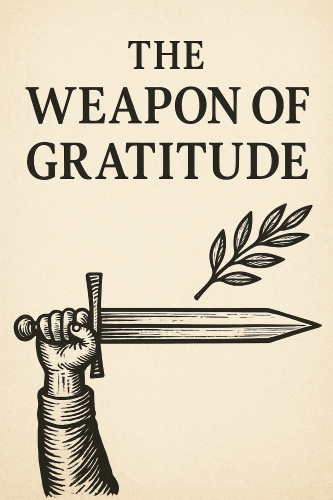
As the year draws to a close, it’s common for many of us to pause and take stock of our journey so far, counting our blessings, yes, but also quietly counting the prayer points that still seem unanswered and things we feel should have happened for us. The effect of this is that some of us end the year grateful, whilst majority of others end it murmuring, wondering why certain promises haven’t yet manifested.
But what if there’s a better way to end the year, one that brings peace, perspective, and keeps us full of God? This article is about that secret, it covers how to end the year well, not in complaint or comparison, but in gratitude. The secret is hidden in a single verse: Romans 1:21 - “Because that, when they knew God, they glorified him not as God, neither were thankful; but became vain in their imaginations, and their foolish heart was darkened.”
How I Discovered This Truth
A few years ago as undergraduate student, I came across this revelation while reading a book by Andrew Wommack titled “the Secret to Staying Full of God”. His insights completely transformed how I viewed gratitude and spiritual stability.
In the book, Wommack explains that many Christians live a “roller-coaster” spiritual life, soaring when they feel God’s presence, then plunging into discouragement when they don’t. He argues that this is not God’s plan. Instead, believers are meant to live consistently full of God’s presence and power, not ruled by emotions, but anchored in truth. He builds this teaching around Romans 1:21, identifying four keys that help believers remain full of God.
The Four Keys to Staying Full of Go
1. Glorify God: To glorify God means to magnify Him, to make Him big in your eyes and heart. Wommack notes that many of us do the opposite: magnifying our problems and minimize God’s power. But when we deliberately focus on God’s greatness, love, and faithfulness, against all odds, our challenges shrink in comparison. In practical terms, this means that each time you face difficulties, you should shift your focus, rather than talking about how big your problem is, declare how big your God is.
2. Be Thankful: The second key is thankfulness. Unthankfulness leads to spiritual dullness (2 Timothy 3:1–2) and has been identified as one of the qualities of the last days (being listed among murder, adultery, idolatry, and some other hideous sins). Gratitude keeps the heart tender toward God and sensitive to His presence. Even when tempted to complain, choose to thank God for His goodness and for past victories He has wrought for you. Gratitude changes your perspective, it reminds you of what God has already done and strengthens your faith for what He will yet do. It’s impossible to remain bitter when your mouth is full of praise.
3. Recognize the Power of Imagination: Your imagination is a tool that reflects how you conceive things inwardly. If your imagination is dominated by fear or failure, that’s what will grow in your life. But if it is filled with the Word of God, it becomes a channel for faith. Wommack encourages us to “see” ourselves as God sees us, healed, whole, righteous, and victorious. You must be able to visualize God’s promises, create reminders, verses, photos, journals, or vision boards that stir your imagination toward faith, not fear.
4. Keep a Good Heart: Everything flows from the heart. Wommack teaches that if your heart is hardened or insensitive to God, no amount of outward effort will produce lasting change. A heart that stays full of the Word remains soft, responsive, and guided by God’s Spirit. This means that you must regularly check your heart as this helps you ensure that you don’t let external worries dominate your thoughts. Rather, your heart should be filled with God’s Word and peace.
Life will always bring challenges and every once in a while, things outside your control will always come your way. However, glorifying, thanking, imagining rightly, and guarding our hearts are within our control and when you effectively engage the above tools, be rest assured that you will live continually full of God. You may not be able to change your circumstances overnight, but you can change the atmosphere of your heart today.
Romans 1:21 paints a sobering picture of what happens when a people lose gratitude. As explained by Apostle Paul, the downfall of humanity began with ingratitude, when people knew God but refused to glorify Him or give Him thanks. Incidentally, once gratitude disappears, pride takes its place, people start taking credit for their achievements, forgetting that every ability and success comes from God. This ingratitude leads to idolatry, exalting created things (money, status, pleasure) above the Creator. The only remedy is repentance and a return to Jesus Christ, the only One who can restore truth, light, and purpose.
Ending the Year Well
As this year comes to an end, don’t focus on what didn’t happen, instead, choose to glorify God and thank Him for all He has done for you and your family so far. Use your imagination to see the promises of God unfolding in your life. Guard your heart against bitterness or doubt because gratitude s a spiritual weapon that protects your heart and keeps you full of God. Let this be the way you end the year, not murmuring nor complaining, but magnifying God and rejoicing. For in gratitude lies the secret to staying full of God.
Have a glorious November!
Author: Loveth Okocha.
The Wilderness Experience

Last weekend, while discussing with a beloved sister, we noted how life does not come with schools and no formal classrooms where we sit to learn the lessons of living. Instead, the challenges we encounter become our teachers. We agreed that the trials we face today are the very classes of life. Some of us are still in “high school” within these challenges, while others, through passing the tests and overcoming difficulties, have gone on to become professionals in life’s lessons. So it is with the wilderness.
Throughout the Scripture, some of the greatest men and women of faith endured wilderness seasons that were not accidental detours, but divine classrooms where God prepared His people for greater assignments. For us today, and I know this from my own personal experiences, the challenges we face often mirror these wilderness experiences. Though difficult and I am in no way undermining what you are going through today, please bear in mind that these challenges carry a purpose: shaping us, strengthening us, and positioning us to return with power.
Examples of Wilderness Journeys
- The Israelites: The children of Israel spent 40 years in the wilderness (Exodus 16; Deuteronomy 8:2). We learn from the Word that what seemed like delay was actually preparation in disguise. God was humbling them, testing their hearts, and teaching them to rely not on bread alone, but on every word from His mouth.
- John the Baptist: John grew strong in the wilderness until the day of his revealing (Luke 1:80). His hidden years of isolation produced a bold prophetic ministry that prepared the way for the coming of our Lord and Savior Jesus Christ (Matthew 3:1–3).
- Jesus Christ: After His baptism, Jesus Christ, our ultimate model, was led by the Spirit into the wilderness to be tempted of the devil (Matthew 4:1–11). There He fasted, faced temptation, and overcame the enemy by the Word of God. Shortly afterward, He returned “in the power of the Spirit” (Luke 4:14), ready to begin His public ministry.
The Purpose of the Wilderness
It may be difficult to comprehend this but one thing I have come to realize is this, the wilderness is not punishment from God most times, rather, it can be a place of preparation and almost an inevitable journey leading up to our launch in life and destiny. Before every major divine assignment comes a season of refining and separation. The wilderness becomes the training ground where God strips us of self-reliance, confronts our hidden weaknesses, and builds in us the strength, humility, and faith required for the weight of our future calling.
Just as every student must go through certain classes before graduation, every believer who desires to walk in the fullness of God’s purpose must pass through the “wilderness classroom.” It is not designed to destroy us but to develop us. The good thing, however, is that for many, this is a once-in-a-lifetime experience, a defining passage that, once completed, prepares you for the rest of your journey. The earlier you submit to the process; the sooner you will emerge refined and ready for the next phase of your assignment on earth.
Yet, attitude plays a crucial role in how long one remains in the wilderness. Engaging the wrong attitude, murmuring, complaining, or resisting God’s dealings can elongate the process unnecessarily. The children of Israel are a clear example. What was meant to be an eleven-day journey turned into forty years because of unbelief and disobedience. Even God acknowledged their needless delay when He said, “You have compassed this mountain long enough; turn you northward” (Deuteronomy 2:3). Their wilderness experience was prolonged, not by God’s inability to deliver, but by their unwillingness to learn.
Apostle James reminds us, “Let patience have her perfect work, that you may be perfect and entire, lacking nothing” (James 1:4). The wilderness refines us like gold in the fire, producing endurance and maturity (1 Peter 1:6–7). When we yield to the process, we come out transformed, ready to carry the anointing and assignment prepared for us.
My Personal Wilderness Experience
I have also had my own fair share of walking through the “valley of Baca.” It was one of the darkest and most refining seasons of my life, a time when it felt as though the world was crashing in on me. Before that season began, God had clearly spoken to me. His words were firm but filled with love: He said He could not use me the way I was. In His exact words, “You are too ajebo for Me.” In Nigerian parlance, ajebo refers to someone who has lived a soft, pampered life, shielded from hardship or struggle. God was essentially telling me that the version of me He intended to use was not the comfortable, sheltered one. Because of the future and the ministry He had prepared for me, I needed to pass through the fire to be refined as gold. Only through my personal wilderness would I gain the compassion, resilience, and understanding required to reach and relate with the people He was sending me to.
It was during that season that Psalm 84 became my anchor, especially verse 6: “As they pass through the valley of Baca, they make it a well.” I learned how to turn my valley (my place of tears) into a spring of life. Those days were incredibly tough. If I never told you how difficult things were, you would never have known, because I made a decision to invest myself wholly in God and His work. Ironically, in that lowest season, I probably won the most souls for Christ and laid the foundational pillars of faith that still uphold my spiritual life today.
Looking back, I realize that the wilderness did not break me, it built me and stripped away pride, taught me about total dependence on God as my source and sustainer, and forged in me a deep compassion for others walking through their own valleys. Truly, when we allow God to lead us through the wilderness, we do not come out empty; we return with power, purity, and purpose.
What to Do in the Wilderness
- Hold to God’s Word: Like Jesus, we must respond to trials with “It is written.” God’s Word sustains and defends us. Don’t let what you go through define you, allow the Word of God to have the final say in your life, contrary situations notwithstanding.
- Turn Valleys into Wells: Psalm 84:6 says, “As they pass through the valley of Baca, they make it a well.” Even in dry seasons, those who trust God can turn pain into refreshment for themselves and others. Chose to focus on the good things God has done for you and look away from the things that are not working. This is one of the most radical ways to confuse the devil, when you maintain joy in chaos, the devil gets frustrated and unsure of your actual state of mind.
- Embrace Patience: Patience in the wilderness is not passive but active trust in God’s timing. It shapes us so we can carry His blessings well.
- Keep Worship Alive: In difficult places, worship becomes your lifeline. Like Paul and Silas in prison (Acts 16:25), praise invites God’s presence into barren seasons.
Returning with Power
Every wilderness has an “aftermath.” The children of Israel entered the Promised land, John the Baptist’s voice shook a nation and Jesus Christ returned from His wilderness full of the power of the Spirit. Likewise, the trials we face today are shaping us for tomorrow’s victories. The effect of a wilderness season is ultimately transformation if you harness the process. You may have entered the wilderness broken, uncertain, and humbled, but, the aftermath is that you will emerge refined, equipped, and empowered for your ministry.
Encouragement for Today
If you are in the wilderness, remember: you are not lost, you are being led. Allow patience to do its work (James 1:4) and do not attempt to skip this class, instead, use this phase as an opportunity to drink deeply from the Word of God. Dig wells in your valley and trust that the God who led you in will also bring you out. And when you emerge, you will not only survive, but you will also return with power, carrying a testimony that strengthens others and glorifies God. “And the Lord shall guide you continually, and satisfy your soul in drought, and make strong your bones; and you shall be like a watered garden, and like a spring of water, whose waters fail not.” (Isaiah 58:1).
Remain ever blessed.
Author: Loveth Okocha
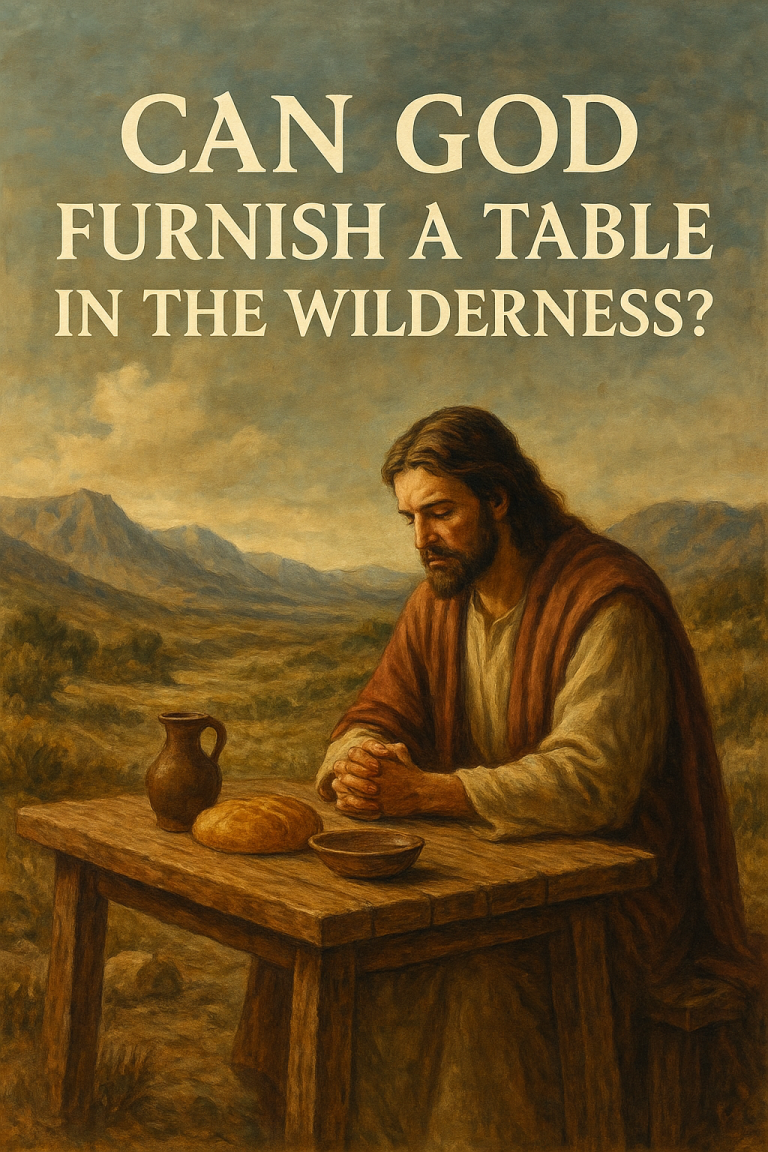
Can God Furnish a Table in the Wilderness?
Many of us often think that the only we can break God’s heart primarily is by breaking one of the Ten Commandments or violating some of the Old Testament rules. Without a doubt, disobedience in these forms displease God. Yet, there is another subtle and often overlooked way we can displease and in fact bring the Lord to wrath: by questioning His capacity.
As a reminder, according to Hebrews 11:6: “… without faith it is impossible to please him: for he that cometh to God must believe that he is, and that he is a rewarder of them that diligently seek him.” Faith is the foundation of our relationship with God, and to doubt Him is to call His character into question. Every time we doubt God’s promises, whether written in His Word or whispered by the Holy Spirit, we inadvertently question and disrespect Him. We imply He is unfaithful and untrustworthy.
Yet, the Bible declares: “For God is not unrighteous to forget your work and labour of love…” (Hebrews 6:10). And again: “If we believe not, yet he abideth faithful: he cannot deny himself.” (2 Timothy 2:13). These Scriptures establish that God’s nature is faithfulness. The type of Father who is not unjust to forget to provide for us in every season of our lives. To doubt Him is not just a lack of confidence in His ability; it is a denial of His unchanging character.
The reality of this subtle disregard for God dawned on me last week whist studying the book of Psalm 78:17–25 (we shall explore this Scripture further below), in the meantime, let’s consider Psalm 23:5, where the Lord says: “Thou preparest a table before me in the presence of mine enemies.” This shows that God is always keen to provide and to cater for His children. To not provide for us would make Him unjust, which is not His nature, He is inherently just. Yet many of us spend more time complaining to God about enemies than enjoying the feast He has already laid out. This was the error of the Israelites in the wilderness when they asked: “Can God furnish a table in the wilderness?” (Psalm 78:19).
Israel’s Doubt in the Wilderness
In Psalm 78:17–25, the psalmist recounts how Israel, despite God’s mighty acts, provoked Him by questioning His capacity to provide: “Yea, they spake against God; They said, Can God furnish a table in the wilderness? Behold, he smote the rock, that the waters gushed out, and the streams overflowed; Can he give bread also? Can he provide flesh for his people?” We see from this passage that the Israelites had seen and experienced the Mighty Hand of the Lord through their “wilderness experience”. In fact, God had already shown His power to them by splitting the Red Sea and bringing water from the rock.
The Israelites even acknowledged that the Lord had given them manna (the angel’s food), yet they still asked if He could provide bread and meat. Their question grieved God, not because of their hunger, but because of their unbelief: “Because they believed not in God, And trusted not in his salvation.” (Psalm 78:22). And yet, even in their doubt, God opened the heavens and fed them with manna, “the corn of heaven”, so that “man did eat angels’ food.” His provision testified to both His power and His mercy.
Faith for Our Wilderness
The same challenge confronts us today. Life presents us with “wilderness” seasons (look out for next week’s article, “Wilderness Experience and Passing through the Valley of Baca”: delays in marriage, the ticking clock of childbearing, struggles with career, immigration settlement challenges, finances, or dreams that seem out of reach. In such moments, there is always this temptation to reecho Israel’s question: “Can God furnish a table in the wilderness?”
But Word of God discourages us from taking this approach and holds us to a higher standard. For instance, Abraham, though his body was as good as dead and Sarah’s womb barren, “staggered not at the promise of God through unbelief; but was strong in faith, giving glory to God.” (Romans 4:20). Against all odds, he trusted God, and in the end, he obtained the promise
A Call to Trust
My charge to you this weekend is this: things may look tough, time may seem against you, the odds may not be in your favor, but never ask that faithless question, “Can God furnish a table in the wilderness?” He has already promised that He can and that He will. He has already prepared the table; your role is to sit and eat, even in the presence of enemies, even in the midst of delay.
Choose to trust God and to believe that He is who He says He is, the faithful God who cannot deny Himself, the rewarder of those who diligently seek Him. Do not let unbelief rob you of the feast He has already prepared for you. The wilderness is not the end of your story because the God who rained down bread from heaven and sent meat to the full will also meet you at the point of your need. All He asks is that you believe.
Remain ever blessed!
Author: Loveth Okocha
Biblical Hacks to Increase Your Value in Life
Value is the regard that something is held to deserve; its importance, worth, or usefulness. In a career or professional setting, value is often measured in monetary terms, your wages, fees, or what an employer is willing to pay for your engagement. This estimation is based on how others perceive your worth in the marketplace. Beyond financial terms, the quality of relationships you are able to attract and sustain is also a reflection of how people value your person, your character, integrity, and the way you enrich the lives of those around you.
From a spiritual perspective, however, value runs much deeper. Your worth is not determined by human perception but by the price God was willing to pay for your redemption. The Bible tells us that God gave His only begotten Son, Jesus Christ, for you (John 3:16). In doing so, He invariably placed on you the same immeasurable worth that He placed on Jesus Christ Himself.
As Apostle Paul writes in Romans 8:32: “He who did not spare His own Son but gave Him up for us all, how will He not also, along with Him, graciously give us all things?” Such a sacrifice makes it clear: nothing else defines your worth spiritually beyond the way God sees you.
The Gap Between Spiritual Worth and Market Value
While your spiritual worth is unarguably settled in Christ, I’ve been privileged to mentor / speak with many Christians who make the mistake of stopping there. They erroneously assume that this intrinsic worth will automatically translate into professional or social value. But the corporate world does not recognize “new birth” as a qualification for employment or higher wages. You cannot walk into an interview and declare, “I am worth the blood of Jesus, so hire me.” The reality is, no employer will pay you simply because God values you.
Some may be tempted to argue that Joseph was elevated to the position of Prime Minister in Egypt because of his affiliation with God. Indeed, Genesis 41:38–39 records Pharaoh acknowledging, “Can we find anyone like this man, one in whom is the spirit of God? … Since God has made all this known to you, there is no one so discerning and wise as you.” Similarly, Daniel and his cohorts remained relevant across successive Babylonian regimes for decades. Daniel 11:32 affirms, “…the people who know their God shall be strong, and do exploits.” Yet, it is important to note that these men did not rely on their covenant relationship with God alone, they also cultivated and demonstrated exceptional skills.
Joseph had developed a rare aptitude for interpreting dreams with clarity, and Daniel exhibited wisdom, knowledge, and administrative excellence that set him apart. Their spiritual connection empowered them, but their value to earthly governments was tied to the tangible contributions they brought. Thankfully, the Bible gives us wisdom on how like Joseph and Daniel, convert our spiritual worth into visible, practical value that allows us to stand out in life and make impact. One of the clearest roadmaps is found in 2 Peter 1:5–11, which lays out a divine progression for increasing our value both spiritually and practically.
The Biblical Hacks: Adding to Your Faith
Peter outlines a chain of growth that begins with faith and builds into a life of fruitfulness and impact. Let’s briefly walk through each step:
- Faith – The Foundation: Faith is the starting point. Hebrews 11:6 reminds us, “Without faith it is impossible to please God.” Faith anchors you in Christ and establishes your spiritual worth. Faith in God’s power (not faith in your abilities) to keep you as the head in the workplace and not the tail. But faith must be built upon to have practical expression.
- Virtue (Goodness) – Excellence of Character: Virtue refers to moral excellence and integrity. In the workplace, skill without integrity erodes trust, but character adds enduring value. Proverbs 22:1 says, “A good name is more desirable than great riches.” Cultivate habits of honesty, diligence, and consistency.
- Knowledge – Wisdom and Understanding: Knowledge expands your competence. Spiritually, this means knowing God’s Word (Colossians 3:16). Professionally, it means continuous learning, training, and development. Knowledge multiplies your usefulness and relevance, people may not like you, but the knowledge you have emersed will ensure you don’t get ignored.
- Self-Control – Discipline: Discipline bridges the gap between potential and results. Proverbs 25:28 warns, “Like a city whose walls are broken through is a person who lacks self-control.” Discipline in your time, emotions, and appetites increases your credibility and productivity. The opposite of self-control is acting unruly and impulsive and these sorts of traits keep people away from you.
- Perseverance – Endurance: Perseverance is the ability to remain steadfast under pressure. Employers, partners, and even ministries value resilience. No one wants to work with people who cannot endure challenges that arise in the workplace day-to-day. James 1:12 promises blessing to the one who perseveres under trial. Endurance adds long-term worth to your character.
- Godliness – Reverence and Devotion: Godliness is living in awareness of God’s presence. It makes you trustworthy, dependable, and consistent. 1 Timothy 4:8 notes, “Godliness is profitable unto all things, having promise of the life that now is, and of that which is to come.”
- Brotherly Kindness – Relational Value: Relationships are capital, it is men that will recommend / approve your promotions, not angels. Brotherly kindness (philadelphia) speaks of love for fellow believers and people around you. Networking, willingness to step in and support colleagues, collaboration, and generosity with others increase your influence and opportunities.
- Love (Agape) – The Highest Value: Love crowns the chain. 1 Corinthians 13 makes clear that without love, every other virtue loses its eternal value. Love is sacrificial, unconditional, and transformative. It draws people to you and magnifies your impact.
The Promise of Growth
Apostle Peter concludes: “For if you possess these qualities in increasing measure, they will keep you from being ineffective and unproductive in your knowledge of our Lord Jesus Christ.” (2 Peter 1:8). In other words, adding these layers to your life ensures that your worth in Christ translates into tangible fruitfulness, both in the Kingdom, in the marketplace and in your relationship with people generally.
He further warns that lacking these qualities leads to shortsightedness, forgetting the very redemption that established your worth (v.9). Conversely, cultivating them guarantees stability, assurance, and eventual entrance into God’s eternal kingdom (vv.10–11). Apostle Peter stresses and rightly so, that “if you do these things, you will never stumble (fall)” (v.10, NKJV). This means that a life built on these qualities keeps you from falling or failing, no matter what the challenges you encounter in life.
Conclusion
Your spiritual worth is settled by the cross, as you saw above, God paid the highest price for you. But to increase your value in life, in the marketplace and in your relationships, you must build upon that worth by intentionally adding virtue, knowledge, discipline, perseverance, godliness, kindness, and love to your faith.
These biblical hacks give practical growth steps that make you more valuable to people, to your profession, and ultimately, to the Kingdom of God.
Remain ever blessed!
Author: Loveth Okocha.

Guarding Your Kairos Moments: Lessons from Ephraim
“When I would have healed Israel, then the iniquity of Ephraim was discovered, and the wickedness of Samaria: for they commit falsehood… Ephraim, he hath mixed himself among the people; Ephraim is a cake not turned. Strangers have devoured his strength, and he knoweth it not: yea, gray hairs are here and there upon him, yet he knoweth it not.” - Hosea 7:1–2, 8–9.
This past week, I finally took some time to audit my life over the last few quarters (long overdue, I must admit). Beyond career and personal matters, I looked more deeply into my walk with God in this season (please don’t ask me what I found - hahaha). This has become a routine I truly enjoy, not only because it brings clarity, but also because it helps ensure I remain in check spiritually. No wonder Apostle Paul exhorted believers to examine themselves, saying: “Examine yourselves, whether ye be in the faith; prove your own selves. Know ye not your own selves, how that Jesus Christ is in you, except ye be reprobates?” (2 Corinthians 13:5).
I asked myself: What habits, attitudes, or distractions might be weakening my intimacy with Him? One by one, I wrote them down, including subtle social media distractions. Once identified, I didn’t stop there. I made a detailed plan and a personal commitment on how to avoid those pitfalls and guard my fellowship with the Holy Spirit. It was after doing this exercise that I stumbled across Hosea 7, where God says: “When I would have healed Israel, then the iniquity of Ephraim was discovered.”
I was slightly taken aback and immediately took some time to understand the context of the above scripture. I was reminded of the battle of attrition in my spirit (I had explored this tactic in the Siniazō series). As previously noted, although Satan no longer has any real power, his tactics remain deceitful. One of his subtlest strategies is to cause us to step out from under God’s covering at the very moment when God has scheduled our visitation.
Chronos vs. Kairos Moments
The Bible uses two Greek words for time:
- Chronos: refers to ordinary, sequential time, days, months, and years passing by. This is not our main focus here.
- Kairos: on the other hand, refers to an appointed, God-ordained time, a window of divine opportunity when God intervenes in human affairs. These are Kairos moments of breakthrough, healing, deliverance or elevation. A Kairos moment is when “the fullness of time” arrives (Galatians 4:4) and God is ready to manifest His promise.
Missing the Kairos Moment
It hit me: just when God wants to lift us, heal us, or take us to the next level in life and destiny, the enemy often sends familiar distractions to derail us. This may come in the form of besetting sin: it reappears right at the edge of your release, your elevation, or your healing. It could even come as new cycles or simple habits that are not sin per se, but the sorts of things which Apostle Paul would classify as lawful, but not expedient in 1Corinthians 6:12.
In Hosea 7:1–2, 8, we see that God longed to heal and restore Israel, but just as the Kairos season of healing arrived, their hidden sins surfaced. Instead of walking into deliverance, Ephraim was entangled in compromise. They became like a half-baked cake, unfit for use. Their strength slipped away, yet they didn’t even notice. Sometimes it’s not that you’re “unlucky” in life, relationships, finance, marriage, or career. It’s that unseen exchanges are happening when you fall back into former patterns. You may not intend to, but when you “relapse” or lack sensitivity for spiritual things, you trade destiny for distraction, progress for pleasure, healing for habit. Like Ephraim, your strength gets devoured and you don’t realize it until much later.
As we know, spiritual things are extremely slippery and Kairos moments do not happen twice in the move of God. If you miss it, you’ve missed it. A good example of a Kairos moment was the night that God delivered the children of Israel from Egypt in Exodus 14. Imagine being an Israelite at that moment. If someone had said, “I’ll wait for another chance,” they’d have missed the exact moment God had orchestrated. That moment was unique and has never occurred again in the history of time. Disregarding Kairos moments would be you assuming that God’s timing is flexible, when in reality, His timing is precise.
The Subtle Return of Besetting Sin
Israel didn’t lose their way overnight. They mixed with the nations, tolerated compromise, and lived half-turned, like a cake left unturned on the pan. Their strength was slipping away, and they didn’t even realize it. Similarly, your biggest battles may not be with obvious sins but with quiet, everyday habits that slowly erode your intimacy with God, for instance, holding on to malice or unforgiveness, allowing laziness to steal prayer and study time, living selfishly, ignoring the needs of others, scrolling endlessly through social media instead of feeding your soul, choosing pride and self-reliance instead of dependence on God.
The Timing of Distraction
Have you noticed that when breakthrough is near, the first sign is often distraction and just when you feel the strongest urge to press into spiritual activities, prayer, fasting, deeper consecration, giving, forgiving, or caring for others, you suddenly find yourself battling laziness, endless scrolling on social media with no real purpose, compromising your standards, struggling to forgive, or becoming tempted to spend everything on yourself alone?
This isn’t coincidence, it’s timing. Whenever God opens a Kairos window, the enemy works simultaneously to throw distractions your way. If you are not discerning, you may end up exchanging your once in a life time elevation for temporary pleasure. The enemy knows that if he can pull you off course in a Kairos moment, you may miss the very release you’ve been praying for. Like Ephraim, you mix yourself too much with the world until your distinction as God’s people begins to fade.
Steps to Guard and Seize your Kairos Moment
- Identify and write down the issues: You cannot overcome what you refuse to name or quantify. Like I did this week, list the habits threatening your intimacy with God.
- Make a plan: Be practical, set clear objectives and when necessary set boundaries, build new routines, and commit to guardrails that keep you aligned. If needed, uninstall and delete social media apps that steal your time and destiny, at least until you are sure you have developed the discipline to use them.
- Discern the timing: When old patterns flare up, ask: What is God about to do in my life that the enemy wants me to miss? Then, you must be smarter than the devil and ensure you don’t give him any place in your life and time.
- Lean fully on the Spirit: Will power won’t be enough, only the Spirit can keep you watchful and strengthen your resolve. This is the period to intensify praying in the Holy Ghost to build you up. Once fully armed, you’d receive the power to then walk in the Spirit to ultimately step into your next season.
Israel missed their moment because they could not discern their season. By contrast, the sons of Issachar “understood the times and knew what Israel ought to do” (1 Chronicles 12:32).We too are called to spiritual discernment. Our Lord Jesus Christ warned that these are perilous times, the last days, when deception, distraction, and compromise will abound. The nearness of the Lord’s return means that every Kairos moment carries eternal weight. That is why the Bible urges us to “redeem the time, for the days are evil” and to live not as the unwise, but as those who understand what the will of God is.
Conclusion
The lesson from Hosea 7 is clear: God is always ready to heal, lift, and restore us, but if left unchecked, hidden iniquities often surface right at the moment of breakthrough. We are in Kairos times, days of divine opportunities, but also days of deception. My charge for you is “remember Lots wife”, stay woke, don’t be distracted nor let besetting sins rob you of your Kairos moment. Redeem the time, understand His will, and remain steadfast in the Spirit until the day of His appearing, keep your heart fully turned toward God, and guard your intimacy with the Holy Spirit as your most valuable treasure. I pray that for every strategic lifting the Lord has prepared for you, you will not miss your season. May you step into the fullness of time in Jesus name.
Remain blessed!
Author: Loveth Okocha

Feelings vs. What God’s Word Says
Feelings are a natural part of being human. God created us with emotions, joy, sorrow, anger, compassion and they all have a place in our lives. However, feelings were never meant to be the final authority for truth or decision-making. They cannot bring the freedom and peace that only the truth of God’s Word can give. God’s Word, not our emotions, is the foundation of faith and should form the main standard for our living.
The Unreliability of Feelings
The Bible warns us that the human heart is unreliable and can lead us astray. The Scripture is very clear on this: “The heart is deceitful above all things, and desperately wicked: who can know it?” (Jeremiah 17:9). Jude 19 further describes those who live by impulses rather than the Spirit: “These be they who separate themselves, sensual, having not the Spirit.”
The word “sensual” refers to being ruled by natural feelings and desires. In contrast, the Bible commands us to walk by faith, not by sight, that is, not by sensory perception (2 Corinthians 5:7). When we allow our emotions to take the lead, we drift from God’s truth and His plans for us, which ultimately results in instability, emotionally and otherwise.
The Reliability of God’s Word
In contrast to our fleeting emotions, God’s Word never changes. The Bible tells us that His Word is settled forever and that His promises in Christ are “Yes” and “Amen.” “Forever, O Lord, Thy word is settled in heaven” (Psalm 119:89). “Heaven and earth shall pass away, but my words shall not pass away” (Matthew 24:35). This means that even when our feelings contradict what God has spoken, His promises remain true. When we feel forsaken, His Word assures us: “I will never leave thee, nor forsake thee” (Hebrews 13:5).
The Rule of Supremacy
Just last week, I was privileged to be supporting a beloved brethren who was feeling the opposite of what we would call the best and rightly so, because a lot had happened to the person that could naturally challenge even the strongest person. In the spirit of honesty, we tried to get to the root of the feelings, which turned out to be a mixture of almost every negative emotion you could imagine.
In an attempt to enthrone the supremacy of God’s Word over those negative feelings, the Holy Spirit reminded me of a profound truth: God is greater than our feelings. As 1 John 3:20 says, “For if our heart condemn us, God is greater than our heart, and knoweth all things.” This is why I call it the rule of supremacy: which means, when your feelings are in conflict with what God says, your feelings must bow. God’s Word is always supreme over your emotions, your circumstances, and your opinions. As real as your feelings are, they are not the final determinant factor on the outcome of your life. God’s Word, which is the truth should have the final say in your heart.
Living by Faith, Not by Feelings
As we’ve seen in (2 Corinthians 5:7): “For we walk by faith, not by sight,” walking by faith means choosing truth over feelings. Faith says, “I may feel one way, but God’s Word says another and God’s Word is final.” This is the opposite of those Jude warns about people led by fleshly impulses rather than the Spirit.
Practical Examples
- Salvation: You may not always feel saved, but God’s Word promises eternal life to those who believe (John 3:16; 1 John 5:13).
- Prayer: You may not feel like God hears you, yet, the Word assures us that “the eyes of the Lord are upon the righteous, and his ears are open unto their cry.” (Psalm 34:15).
- Obedience: You may not feel like forgiving or showing love, but God’s Word commands you to forgive at all times (Ephesians 4:32; John 13:34).
Bringing Feelings into Alignment with the Word
Please note that this charge is not aimed at getting you to deny your feelings, far from it. Rather, it is charging you to bring those negative and contrary feelings under the authority of God’s Word and thankfully, God has given us tools for this:
- Renew your mind daily with God’s Word (Romans 12:2). It is in the place of renewal that negative thoughts are displaced with the truth of God’s Word.
- Take every thought captive. “Casting down imaginations, and every high thing that exalteth itself against the knowledge of God, and bringing into captivity every thought to the obedience of Christ.” (2 Corinthians 10:5). Every thought process that is not in alignment with God’s Word say must kowtow.
- Think on the right things. “Whatsoever things are true, whatsoever things are honest, whatsoever things are just, whatsoever things are pure, whatsoever things are lovely, whatsoever things are of good report; if there be any virtue, and if there be any praise, think on these things.” (Philippians 4:8).
These disciplines tame our wild thoughts and emotions, training them to submit to Christ and His Word.
Conclusion
Jude 19 shows us the danger of living by feelings: it separates us from the Spirit and from one another. But when we live by the rule of supremacy, God’s Word over feelings we are reminded that God is greater than our feelings. His Word steadies us when our emotions shake us and by the help of the Holy Spirit, we can capture our wandering thoughts, resulting in God’s truth filling our minds with what is pure and lovely. Remember, feelings shift and thoughts wander, but God’s Word reigns supreme, now and forever.
Remain lifted!
Author: Loveth Okocha
From El Roi to Joint-Heirship: The Rule of Joint Ownership
Yesterday, I got into a conversation with someone about this new movement among many Christians who passionately refer to God as El Roi “the God who sees me.” For context, the phrase comes from the story of Hagar in Genesis 16, when she was mistreated by her mistress, Sarah, and fled into the wilderness. As a servant, Hagar had no inheritance in her master’s household. She was nameless, unnoticed, and unseen by the world around her. Yet, in her distress, God met her, gave her water for her child, and even created a small inheritance for her seed. Out of gratitude, she called Him El Roi, the God who sees me.
It was a moving story, a demonstration of God’s benevolence and goodness even to those outside the Abrahamic covenant. But as touching as it is, I’m prompted to clarify that El Roi is not the name God chooses to introduce Himself to His covenant children. Not to our patriarchs in faith, nor to you and me today. For Hagar, God being the One who “sees” her was everything. But for us who are in Christ, the seed of Abraham (Galatians 3:29), God wants us to know Him as far more than El Roi. Please note that this article is not an attempt to dissuade people from calling God different names based on their circumstances, but simply an attempt to show a more excellent way and reveal the heart of the Father.
Relating with God “solely” as your El Roi is like a child calling his father “the philanthropist” or “the president.” True as that may be, the greatest revelation a child can have is not his father’s public title but his personal identity: Father. This is why the Jews sought to stone Jesus when He called God His Father (John 5:18). They understood how radical that was, a claim of sonship, source, and sustenance.
A father is both a source and a sustainer, and that is how God desires us to know Him; and as His children, we are not only called sons and daughters but also heirs. Paul writes: “The Spirit Himself bears witness with our spirit that we are children of God, and if children, then heirs, heirs of God and joint heirs with Christ…” (Romans 8:16–17). This is where many also misunderstand things, interpreting “joint-heirs” as though it meant “co-heirs.” But the two are not the same as the Father did not reduce Christ inheritance so that we might have a part; He brought us into His inheritance so that we might go beyond “being seen” to having full access to all that Jesus enjoys.
The Rule of Ownership
Under earthly inheritance law, there are two common ways people hold property together, that is by joint tenancy or co-tenancy (tenancy in common). In joint tenancy, two or more people own the property together as a single unit and each owner has an equal and undivided interest in the whole property (not fractions). For instance, where two siblings own a house in joint tenancy; each owns 100% together. If one dies, the other becomes the sole owner. In contrast, co-tenancy (or tenancy in common) is a form of property ownership where two or more people own the property in separate shares. The shares may be equal or unequal (e.g., 50:50, 70:30, 95:5, etc.). A good example is where two business partners buy land; one owns 90%, the other 10% interest in the land.
Additionally, in co-tenancy (tenancy in common), each person owns only a part, which can be separated or passed on. If two people inherit an estate, they might split it 50:50, or in other ratios such as 70:30. Each owns a severable portion and what belongs to one is not automatically accessible to the other.
Joint Heirs with Christ
However, the Bible never used the term “co-heirs” nor co-tenancy in describing the sort of inheritance that our Heavenly Father has bequeathed to us through Christ. Instead, the Bible says that we are “joint-heirs” with Christ (Romans 8:17). This is more like joint tenancy, where each person owns the whole estate in full, with no severance or division. In Christ, there is no fraction, no split, no minority share, and you and I don’t have less access to the inheritance in disproportionate shares than Christ.
The Bible says that “all things are yours” (1 Corinthians 3:21) and “you have been blessed with every spiritual blessing in the heavenly places in Christ” (Ephesians 1:3). If the Bible had called us “co-heirs,” it would suggest that God divided His blessings, giving some to Christ and some to us as co-heirs to inherit by division. But, that is not the position, the rule of joint ownership in a nutshell is: what Christ has, you have, fully and forever and there is no division of the inheritance. Each party (Christ on the one hand and you on the other hand) owns the whole estate in its entirety. No one gets a lesser fraction nor any fraction at all; all share in the full possession.
This means that in Christ:
- You don’t have “your piece” of healing while He has another. All of His health, life, and wholeness is yours (Isaiah 53:5 and John 1:16).
- You don’t receive a fraction of His authority while He keeps the rest. The same power that raised Christ from the dead dwells in you (Romans 8:11 and Colossians 2:9–10).
- You “As He is, so are we in this world” (1 John 4:17).
- You are not waiting for a share of heaven’s blessings. All things are yours already (1 Corinthians 3:21) and you are blessed with all spiritual blessings (Ephesians 1:3).
Living Out the Reality of Joint-Heirship
Understanding this truth transforms how we pray, believe, and live the life that the Father has designed for us. Instead of merely thanking God for seeing you and asking for “a little portion,” we should boldly receive the fullness of what Christ has. Instead of comparing ourselves to others’ blessings, we rest in the fact that we already share the whole inheritance. Instead of seeing lack, we see abundance, for we have inherited God Himself. This is because when you call God your Father, you are not merely appealing to His role as El Roi, the God who sees you, rather, you are stepping into the fullness of sonship, joint ownership, and divine inheritance.
Conclusion
The believer’s inheritance in Christ is not divided, diminished, or shared out in percentages. The rule of joint ownership declares that every child of God owns the whole estate of Christ, that is 100%. This is not mathematics; but a status that has been bestowed on you and me by the grace of God, our Heavenly Father. In effect, the heavenly arithmetic says that if Christ has it, so do you.
Remain ever blessed and be assured that you are not just seen by God, you are His child, His heir, and a joint-heir with Christ!
Author: Loveth Okocha
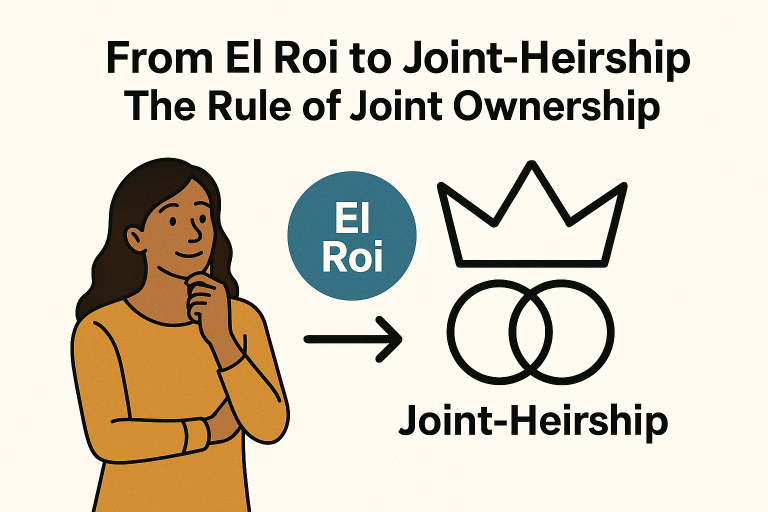
Warring for the Faith: Fighting the Battles That Still Matter
I know we had originally scheduled to move into the subject of Sanctification this week as part 7 of the Skēnoó: The Art of Tabernacling series. However, for some reason, I feel strongly compelled to interject that plan and write about something else. Incidentally, this is now the second time the Holy Spirit has interrupted the subject of Sanctification in favor of another topic. What is He “cooking” with Sanctification? It must be massive and I genuinely cannot wait to see what He has up His sleeve with that subject. Hopefully, it will unfold in the coming weeks, but in the meantime, I yield.
So, this week, we are looking at war. Yes, you heard me right, war. War is a deeply rooted biblical subject. Contrary to modern pacifist theology, God Himself is a Man of war (Exodus 15:3: "The Lord is a man of war: the Lord is his name), and He teaches us how to fight, not with carnal weapons, but with spiritual readiness and discernment. “Blessed be the Lord my strength, which teacheth my hands to war, and my fingers to fight:” Psalm 144:1. “He teacheth my hands to war, so that a bow of steel is broken by mine arms.” 2 Samuel 22:35.
So, if you are not fighting, not warring, or not learning to fight, but are just resting, spiritually passive, I would go as far as to say: you may not be in the perfect will of God for your life.
Not Every War Is Still Ours to Fight
The kind of warfare we are called to must be carefully defined to align with the orders of Jehovah, the Man of war. Some believers today are still fighting wars that Jesus already won: war against the devil, against the world, against sin and the consequences thereof. Let me be clear: these battles have been completed, the victory was won once and for all by Christ.
- “And having spoiled principalities and powers, he made a shew of them openly, triumphing over them in it.” - Colossians 2:15.
- “Behold, I give unto you power to tread on serpents and scorpions, and over all the power of the enemy: and nothing shall by any means hurt you.” Luke 10:19.
- “These things I have spoken unto you, that in me ye might have peace. In the world ye shall have tribulation: but be of good cheer; I have overcome the world.” - John 16:33.
- “Who his own self bare our sins in his own body on the tree, that we, being dead to sins, should live unto righteousness: by whose stripes ye were healed.” - 1 Peter 2:24.
These battles are not ours anymore, we simply need to align ourselves to the finished work of Christ and take hold of the victory that Christ already obtained for us. To keep fighting Satan as though he hasn’t been disarmed is to unknowingly deny the finished work of the cross. The real battles God calls us to now are different, they are deeper, more internal, more generational, and more foundational.
This is why the Bible makes it clear that “the weapons of our warfare are not carnal, but are mighty through God to the pulling down of strongholds, casting down imaginations and every high thing that exalts itself against the knowledge of God, bringing every thought into captivity to the obedience of Christ” - 2 Corinthians 10:4-5.
Essentially, the above scripture emphasizes that the wars we are called to fight are not merely personal battles of faith, but a spiritual fight against any belief system or force that exalts itself against the faith in God and the knowledge of our Lord and Savior Jesus Christ. With that in mind, let’s now examine two primary biblical kinds of war that we are still called to fight:
- Fight the Good Fight of Faith
“Fight the good fight of faith, lay hold on eternal life, whereunto thou art also called, and hast professed a good profession before many witnesses.” - 1 Timothy 6:12. This is a lifelong war, the war to trust God, to remain faithful through trials, and finish well. I already explored this more deeply in my earlier piece on “Siniazō: The Trial of Faith” (you can catch up on the series using this link - https://www.devotionlegalhub.online/article-2/), but it bears repeating.
This type of warfare requires perseverance, especially in dark seasons. It demands staying anchored in the Word, obedient, and spiritually awake, no matter what the external conditions look like. Job demonstrated this kind of enduring faith when he declared: “Though he slay me, yet will I trust in him: but I will maintain mine own ways before him.” Job 13:15. This verse shows that Job not only believed when it was easy for him to; rather, he kept on believing God through the slaughter. This is what real spiritual warfare looks like, fighting to hold onto God’s promises even when nothing around you makes sense.
The Apostle Paul also fought this way. In 1 Corinthians 9:26-27, he described how he fought to keep his own faith till the end: “I therefore so run, not as uncertainly; so fight I, not as one that beateth the air.” Near the end of his life, he could boldly declare: “I have fought a good fight, I have finished my course, I have kept the faith:” 2 Timothy 4:7. That is what finishing well looks like, a fight to keep the faith till the end no matter what comes our way.
2. Earnestly Contend for the Faith
“Beloved, when I gave all diligence to write unto you of the common salvation, it was needful for me to write unto you, and exhort you that ye should earnestly contend for the faith which was once delivered unto the saints.” Jude 1:3.
The word contend is from the Greek word “epagōnizomai”, which implies struggling intensely like an athlete or soldier. It could also mean the art of vigorously defending what is precious. It's a spiritual battle or warring to ensure that the unchanging truth of the Gospel is not diluted, compromised, or forgotten, but upheld with passion, humility, and conviction.
This type of warring goes beyond your personal walk with God and touches upon the collective Faith, the doctrines, beliefs, revelations, convictions, and truths passed down from one generation of saints to another. It’s one thing to believe for yourself. It’s another to fight, to contend to preserve and transmit that faith to the next generation. This is the heart of legacy spiritual warfare.
This is why we do what we do. Someone once asked why I bother, paying monthly for a website and consistently publishing articles. My answer is simple: to pass on the faith handed to me by the Holy Ghost and the fathers of faith. If it were just about my personal walk, I wouldn’t even be bothered. And by the help of God and the Holy Spirit, I intend to preserve my own walk with Him. But it goes beyond that, it’s about contending for the collective faith and passing it on. It is for this reason I ask you to pass the link on to others, hahahaha.
It was for this same reason that God had such confidence in Abraham. It wasn’t just about his personal faith, it was about his intentional transmission of faith. “For I know him, that he will command his children and his household after him, and they shall keep the way of the Lord, to do justice and judgment; that the Lord may bring upon Abraham that which he hath spoken of him.” Genesis 18:19.
God didn’t say Abraham would urge or suggest to his children to follow the Lord. He said Abraham would command them to follow God. Today, we live in a culture where faith transmission is often optional, especially in the West. Children are being given freedom, the freedom to choose their gender, their sexuality, their identity, and their belief system, even when these things blatantly oppose God’s order. But God did not call us to be passive parents and Christians. He didn’t call us to blend in, and sadly, there are many tragic biblical examples of this kind of fatal passivity.
When the Faith was not Contended For, and What it Cost
Throughout the Bible, there are moments where heroes of faith failed to defend, model, or transmit the faith, especially to the next generation. The consequences were often spiritual decline and loss of legacy.
- Eli: He Knew, but Did Not Restrain
“For I have told him that I will judge his house forever for the iniquity which he knoweth; because his sons made themselves vile, and he restrained them not.” - 1 Samuel 3:13. Eli’s sons were priests, yet they abused their roles, committing sexual immorality and taking offerings by force. Eli knew and even warned them (1 Samuel 2:23–25), but he failed to discipline them decisively. His passive response, “It is the Lord: let Him do what seemeth Him good” (1 Samuel 3:18) revealed resignation to fate and not a vigorous contention. His failure to contend led to God’s judgment on his house and the loss of the priesthood from his lineage.
- Samuel – A Godly Man, but Absent at Home
“And it came to pass when Samuel was old, that he made his sons judges over Israel... and his sons walked not in his ways, but turned aside after lucre, and took bribes, and perverted judgment.”- 1 Samuel 8:1, 3. Samuel was a faithful prophet and judge, yet his sons, Joel and Abiah, did not follow his example. They became corrupt leaders, triggering Israel’s demand for a king, which ultimately altered the nation's structure. Though not guilty of immorality himself, Samuel’s failure to “earnestly contend for the faith which was once delivered” to him, by raising successors in righteousness meant the faith and leadership mantle were not sustained.
The Battle to Keep Faith Alive in a Dying Culture
In effect, this sort of war is beyond home war, instead, it touches upon church war, societal war, and generational war. Across the Western world, churches are closing doors. In some parts of London for instance, Sunday services see as few as two attendees. Meanwhile, social events, clubs, and carnivals overflow with uncontrollable crowds. In the corporate environment, faith in Christ is not something that is widely celebrated. Speak of church, and you’re almost viewed as antisocial. But talk about ideologies contrary to the Word of God, and you are celebrated. I’m not trying to sound sanctimonious, but this is the reality many believers are facing daily.
And yet, we must not keep quiet. You must find wise ways to war, to keep the name of Jesus in every street, room, and office, until the glory of the Lord fills the earth, as the waters cover the sea. This is our battlefield today. This is the real war, to contend for the faith that was once delivered to us by patriarchs like: John Wesley; Reinhard Bonnke; Smith Wigglesworth; Charles Spurgeon; Kathryn Kuhlman; Bishop David Oyedepo; Kenneth E. Hagin and Billy Graham, etc. We must not just maintain our own faith to the end, rather, we must ensure that it lives on, that it multiplies, that it is contended for and transferred to generations to come.
Do the Work of an Evangelist
To contend and transmit the faith, one vital responsibility that Apostle Paul commands us to do is: “Preach the word; be instant in season, out of season; reprove, rebuke, exhort with all longsuffering and doctrine.” - 2 Timothy 4:2. “But watch thou in all things, endure afflictions, do the work of an evangelist, make full proof of thy ministry.” - 2 Timothy 4:5.
You don’t need to hold the title of an evangelist, but you must be ready to do the work of one. When someone approaches you, struggling with their faith, don’t respond with, “Same here, my problems are even worse.” That is not how we contend for and preserve the faith. Instead, step up. Exhort, reprove, rebuke when necessary, be ready to preach the Word, in season and out of season (2 Timothy 4:2).
Conclusion
The charge before us today is clear: to war, to fight earnestly for our individual faith, to contend passionately to preserve and transmit the collective faith, and to boldly take territories for Christ. These are the wars that remain, not against the devil, not against sin, not against the world, but a war for the faith, a war for the next generation, and a war for the Kingdom of God.
In a generation that echoes the words in Job 21:15: “What is the Almighty, that we should serve him? And what profit should we have, if we pray unto him?”, we must rise to outline the numerous benefits that accompany serving and praying to God. We should be ready to defend and advance the collective faith by declaring with conviction the very words of Queen Esther in Esther 4:16: "if I perish, I perish." This declaration by Queen Esther was made at a time when she decided to risk her life to approach the king and plead for her people, although doing so was against the law. In the context of this article and the implication of this statement in our clime essentially urges us to war for the purposes or preserving the collective faith, to a point that we can say: "I will do what must be done, even if it costs me everything." This is what it means to war for the faith.
So, I ask you today: are you ready to war this week? Ready to fight, to contend, and to pass on the faith with unwavering resolve? And when they ask you, “Who is the Almighty that we should serve Him, what will your answer be? Will you stand firm, knowing the battle is not just around us, but within us, and for those yet to come?
The time to war is now. Will you join the fight?
Remain ever blessed!
Author: Loveth Okocha
“Nevertheless, at Thy Word” I will let down the Net...
In the month of May, I found myself in close communication with a dearly beloved sister from the Church, someone who over time has become like family to me. She had been earnestly job hunting for months, knocking on every door she believed God might open. But one rejection followed another. And on the very day I felt prompted in my spirit to call her, she had just received yet another “no.” The final rejection email that week came with a frustrating explanation: she had failed to mention one key aspect of the role during her interview, not because she was unqualified, but simply because that one detail had been missed.
She was exhausted, mentally, emotionally, and spiritually. Hope was fading fast, and the idea of applying for yet another job felt like self-inflicted torment. She wasn't sure she could take another blow, and who could blame her? At this point, she had decided to take a break from it all to preserve what was left of her mental and emotional strength.
But God:
During our 40-minute phone conversation, before we prayed, I was led to share a scripture that I had studied that very morning, a passage that has strengthened me in my own journey countless times. It was Luke 5:1–7, with emphasis on verses 4 to 6: "Now when he had left speaking, he said unto Simon, Launch out into the deep, and let down your nets for a draught. And Simon answering said unto him, Master, we have toiled all the night, and have taken nothing: nevertheless at thy word I will let down the net. And when they had this done, they inclosed a great multitude of fishes: and their net brake."
Peter, a professional fisherman, skilled, seasoned, and experienced, had spent the entire night fishing and had caught nothing. All his methods, tools, and knowledge had failed him. He was done, likely cleaning up, discouraged but accepting of the outcome and then Jesus entered the scene. Jesus, who was not a fisherman by trade, asked Peter to do the very thing he had done all night: to cast his net. The instruction seemed redundant at the time, but Peter’s response is what turned everything around, “Nevertheless, at thy word…”
That word, nevertheless, is a word of surrender, of faith, of trust against all odds. It’s what happens when you move not because of your strength, but because of His word. It is mostly very helpful when you have done all that you know to do. Back to my sister’s story, after our call and prayer, she found the courage to apply for one more job. Just one more. The odds didn’t look better than before. But she obeyed the prompting. After several rounds of interviews, I was pleasantly thrilled to hear mid last week that she was offered the job! The same woman who had toiled for months with nothing to show for it, let down her net one more time, and this time, it was full.
To anyone reading this who feels like giving up, I ask you: could this be your moment to let down your net again? Maybe you’ve been rejected over and over again, in job applications, relationships, ministry opportunities, or personal battles. You feel drained and defeated. But hear this: God is not done with you yet. This season might not be one of immediate fruitfulness, it might feel more like pruning, but don’t mistake silence for absence. God is still speaking and sometimes, all He needs is your willingness to try one more time, this time in absolute faith in Him, not just effort.
Scriptures to Encourage You to Try Again:
- Galatians 6:9 - "And let us not be weary in well doing: for in due season we shall reap, if we faint not."
- Proverbs 24:16 - "For a just man falleth seven times, and riseth up again: but the wicked shall fall into mischief."
- Isaiah 40:29-31 - "He giveth power to the faint; and to them that have no might he increaseth strength… But they that wait upon the Lord shall renew their strength…"
- 2 Corinthians 4:8-9 - "We are troubled on every side, yet not distressed; we are perplexed, but not in despair… cast down, but not destroyed."
- Romans 5:3–5 - "…we glory in tribulations also: knowing that tribulation worketh patience; And patience, experience; and experience, hope: And hope maketh not ashamed..."
- Psalm 126:5–6 - "They that sow in tears shall reap in joy. He that goeth forth and weepeth, bearing precious seed, shall doubtless come again with rejoicing..."
- James 1:12 - "Blessed is the one who perseveres under trial because, having stood the test, that person will receive the crown of life..."
Final Charge:
Beloved, please know this as you know your name, your story isn't over yet, you may have toiled all night, but your dawn has come. In Isaiah 60:1, your Lord commands you to “Arise, shine, for your light has come, and the glory of the Lord rises upon you.” And in this dawn, it is not your experience or effort that will make the difference, it is your obedience. In Zechariah 4:6, the Lord says you’d succeed this time, “not by military might or by your own strength, but by my spirit.” When Jesus says, “Let down your net,” you can either focus on your fatigue or trust in His word, please choose to focus on your faith in God. So, to you, weary soul, this is your moment, arise, shine, for your light has come, nevertheless, let down your net.
Be ever blessed!
Author: Loveth Okocha
“By This Time He Stinketh”
Have you ever looked at a situation in your life and thought, “It’s too late… nothing can be done now”? Maybe it’s a long-standing illness, a broken relationship, a career that has flatlined, marital delay, childlessness, immigration issues, or a dream that feels long dead. All around you, voices echo what Martha said when Jesus arrived at Lazarus’ tomb: “Lord, by this time he stinketh” - John 11:39. That phrase, “By this time he stinketh” has been ringing in my spirit all week. I kept hearing it over and over, even as I prayed. And I knew the Holy Spirit was preparing a message of hope for someone this weekend. If you’re reading this, this word is for you: It is not too late. God is never late and your case is never hopeless.
Hope for the Living
To understand how God moves, we must first lay a foundation of hope as captured in Ecclesiastes 9:4: “For to him that is joined to all the living there is hope: for a living dog is better than a dead lion.” This verse assures us that as long as you are alive, there is hope and your story is far from being over. One of my strongest conviction in life is that for the child of God, no situation is ever truly hopeless, because Jesus Christ is alive, and He is our Living Hope: “Blessed be the God and Father of our Lord Jesus Christ, which according to his abundant mercy hath begotten us again unto a lively hope by the resurrection of Jesus Christ from the dead.” 1 Peter 1:3.
Even when everything seems cut off and finished, God reminds us that there is hope for a tree. “For there is hope of a tree, if it be cut down, that it will sprout again, and that the tender branch thereof will not cease. Though the root thereof wax old in the earth, and the stock thereof die in the ground; Yet through the scent of water it will bud, and bring forth boughs like a plant.” - Job 14:7–9. This is a powerful image, even when what once stood tall is reduced to a stump, even when the roots seem buried in dryness and age, just a scent of water, the presence of the Spirit, can bring life again. If there’s hope for a tree, there’s certainly hope for you. As long as you are connected to the Living Water, you can rise again.
Lazarus: A Case That Seemed Too Far Gone
The Book of John is one of my favorite books in the Bible, and John the Beloved is, in fact, one of my favorite Bible heroes. In John 11, he records a powerful story that none of the other Gospel writers include, the account of three siblings: Mary, Martha, and their brother Lazarus, who became gravely ill and eventually died. Before Lazarus passed away, his sisters did everything they knew to do. They sent word to Jesus early, fully believing He could heal their brother. But Jesus did not arrive when they expected Him to. We later learn that Jesus deliberately delayed so that the situation could bring glory to God.
By the time Jesus finally arrived in Bethany, Lazarus had been dead for four days. Martha met Him with the kind of faith many of us have, faith that believes in healing, but not necessarily in resurrection. She said, “Lord, if You had been here, my brother would not have died,” indirectly implying that Jesus was late. But Jesus is never late and His timing is not ours. Then came a pivotal moment, Jesus said, “Take ye away the stone.” But Martha, the ever-practical sister, responded with deep realism mixed with grief: “Lord, by this time he stinketh: for he hath been dead four days” - John 11:39.
For the avoidance of doubt, this wasn’t just a case of sickness anymore, at this time, Lazarus was gone and long enough for decomposition to begin and his body stank. The situation was not only hopeless by human standards, but it was also offensive, decaying, final. And yet, Jesus called him forth. He wanted everyone to see that even when it looks too late, when death has taken over, when decay has set in, God still has the final word. One assurance to hold on to is that stenches don’t scare Jesus as He specializes in rolling away stones, calling forth the dead, and bringing glory out of impossible circumstances.
God Specializes in “Stinking” Situations
Some of you today are standing before your own symbolic "tomb": Perhaps, yours is a failed business, a broken marriage, a body the doctors say cannot conceive, a prayer you’ve given up on. You may even feel spiritually distant, like the person who once told me, “I’m not on speaking terms with God anymore,” after losing a loved one to cancer despite fervent prayers. But please hear this: God is still in the business of turning death into life. Many times, He allows certain things to happen for His glory. The worse it looks, the greater the glory He receives when He turns it around.
Jesus specializes in situations that stink, what seemed hopeless for Mary and Martha ended in rejoicing. These same women are later referenced in Hebrews among those who “received their dead raised to life again.” As long as you are breathing and joined to the Living God, there is hope for you, and by putting your full trust in Him, your story too can become one of those told to demonstrate the greatness of His power.“Jesus saith unto her, Said I not unto thee, that, if thou wouldest believe, thou shouldest see the glory of God?” John 11:40.
Your Faith Has a Role to Play
Jesus has the right, the power, and most importantly the willingness to turn your case around. But you must meet Him with obedient faith, not a passive faith that waits indefinitely, but katelambanō faith, the kind that reaches out and actively takes hold of what belongs to you in Christ. Your situation is not too far gone. What was declared “dead” in your life can live again. The same voice that called Lazarus out of the grave can call your destiny back to life.
Final Charge
Don’t let the voices of fear, doubt, or even logic tell you it’s over. If Jesus could raise Lazarus, He can raise your dream, He can regularize your immigration papers, cause you to conceive, restore your health, your marriage, your joy, your purpose. You may have heard, “By now, it stinketh,” but I join the voice of the Lord to declare to you: “I am the resurrection, and the life…” John 11:25. As long as He is involved, it is never too late and I look forward to your testimony.
Remain blessed!
Author: Loveth Okocha
The Elder Brother Syndrome: When the Holy Spirit Redirects You
Whenever I read Luke 15, like most people, I naturally focus on the prodigal son, the one who walked away, wasted everything, and returned home to mercy. But the Holy Spirit has always had a way of pulling me back from the “obvious rhema”. Time and time again, He gently highlights what others might overlook, not to criticize, but to teach, correct, and strengthen me in truth and in my walk with Him. It is on that note that He didn’t allow me to stay focused on the prodigal son this time, instead, He opened my eyes to the elder brother, the one who stayed home, followed the rules, but nonetheless, completely missed the heart of the Father. What I’m about to share is not the usual angle on Luke 15, but it’s one of the most sobering lessons the Holy Spirit has taught me, and I believe it’s worth sharing, I call it the “Elder Brother Syndrome”.
Elder Brother Syndrome, what is that?
To understand this syndrome, we must first look at Luke 15:25–30, which describes the reaction of the elder brother in the parable of the prodigal son: “Now his elder son was in the field… and he was angry, and would not go in: therefore came his father out, and intreated him. And he answering said… Lo, these many years do I serve thee… but as soon as this thy son was come… thou hast killed for him the fatted calf.”
From this passage, I’d describe the Elder Brother Syndrome as a self-righteous and resentful attitude, marked by outward obedience but inward bitterness. It reflects a heart that struggles with grace, lacks compassion, and resents mercy shown to the undeserving. The elder brother couldn't rejoice in his sibling’s return because he was too focused on fairness and reward, forgetting the heart of the Father, which is to save and restore all men.
Avoiding the Elder Brother Syndrome
From a human perspective, the elder brother did everything “right,” he never asked for his own share of the father’s inheritance, never engaged in riotous living, nor leave his father’s house off to a strange land, he was always in the house. However, although physically present, his heart posture was not in alignment with his father and the spirit of mercy. From his response, you could tell he was faithful, but proud. He was present, but simultaneously bitter. He wanted grace for himself but couldn’t stand to see it freely given to someone else.
The above, to me, is one of the quiet dangers of spiritual growth: when you’ve walked with God long enough, served long enough, or consecrated yourself long enough, it becomes easy to forget how far God has brought you. It’s easy to begin to compare yourself with others and in some cases, you start expecting explanations from God. You want to be kept in the loop when someone else is restored or elevated. But the mercy of God is not a group decision it’s His to give.
As God helps us grow in consecration and holiness, He also calls us to walk in deep humility. The grace to live by godly principles does not make you the gatekeeper of someone else’s journey. Instead, it positions you to pray, to love, and to stay focused on your own obedience. God does not always reveal to you what He’s doing in another person’s heart. He is sovereign in mercy, and He restores people in ways you may not expect. “Wherefore let him that thinketh he standeth take heed lest he fall.” 1 Corinthians 10:12.
Don’t Become a Modern-Day Pharisee
As church people, we don’t always realize when we start acting like Pharisees. You might think you’re simply upholding standards, but without love and humility, those “standards” can turn into stumbling blocks. We end up expecting people to be clean before they get into the shower. But the Church is not a place for the already perfect, it’s a spiritual laundry. It’s where people come to be washed, renewed, and transformed by the Spirit of God. And that process is messy. The scriptures commands us, “Judge not according to the appearance, but judge righteous judgment.” John 7:24 and “Man looketh on the outward appearance, but the Lord looketh on the heart.” 1 Samuel 16:7b.
Be a Bridge and not a Barrier
God is seeking people who will serve as bridges, and as those who help others reconnect to Him, not as barriers that block the way. In a world where many are already burdened by shame, guilt, and brokenness, the Church should be a place of healing, not judgment. When someone walks into our church, perhaps not dressed the way we’d expect, maybe still carrying the scent of where they've been, allow the Holy Spirit to use you to show them kindness, not critique. Let them encounter the love of the Father, not the frown of the “elder brother” (Luke 15:25–32). We should take our cue from how God has treated us: “But God commendeth his love toward us, in that, while we were yet sinners, Christ died for us.” Romans 5:8.
God did not wait for us to become perfect before extending His love. He loved us at our worst, at our messiest. That same grace should shape how we treat others. Before rushing to criticize or condemn someone else’s journey, pause and remember: you’re not called to clean people, Jesus does that. You’re called to welcome them, love them, and walk with them as He transforms them. As the prophet Micah reminds us: “He hath shewed thee, O man, what is good; and what doth the Lord require of thee, but to do justly, and to love mercy, and to walk humbly with thy God?” Micah 6:8.
Let that be the measure: Are you walking in mercy? Are you making space for others to grow? Or have you slipped into the posture of the elder brother, resentful, outside the celebration, forgetting that grace was extended to you too?
Final Charge
We are called to be bridges, people who open doors for others to get into the fold and in doing this, represent Christ best when we extend love, patience, and truth in grace. So today, ask yourself:
- Am I leading others toward Christ or pushing them away?
- Am I a safe place for the broken to begin again?
- Will I celebrate the lost when they return, or will I stand outside, arms crossed like the elder brother in Luke 15?
Receive the grace to allow God’s love to flow freely through you to others in the mighty name of Jesus!
Remain ever blessed.
Author Loveth
From Milk to Meat: Growing in Christian Maturity
I recently came across a finding that human beings are the only species in the kingdom Animalia that consume milk into adulthood. While all mammals feed milk to their young during infancy, most animals eventually transition to solid food and stop drinking milk altogether. Even more concerning is the claim and the ongoing debates about whether continued milk consumption in adulthood is associated with certain health issues. I could argue that this natural progression reflects God’s original design for spiritual growth as well.
As humans, however, we often cling to certain comforts, milk being a familiar one. I for one cannot survive without evaporated milk, hahahaha. But, While milk is vital for early nourishment and growth, both physically and spiritually, it is meant to be a starting point, not a lifelong sustenance. As we mature, we are called to move on to more substantial food. In the Christian faith, this serves as a powerful analogy for spiritual maturity: we are expected to grow beyond the basics, seeking deeper understanding and greater wisdom in our walk with God.
Milk: The Foundation of Spiritual Growth
Milk, as referenced in the Bible, is a metaphor for the fundamental truths of the Christian faith. It is something that is essential for spiritual babes, as it provides the nourishment needed for initial growth. In 1 Peter 2:2, the Apostle Peter writes, “As newborn babes, desire the sincere milk of the word, that ye may grow thereby.”
Just as infants need milk to develop their physical bodies, we need the foundational truths of God’s Word to grow spiritually. These basics include salvation through Christ, the promises of God, and the essential teachings of the Gospel. However, there is a danger in staying at the milk stage indefinitely. While milk is good for infants, it is meant to be a stepping stone, not a permanent diet. Just as a child is expected to wean from milk and begin eating solid food, we are called to move beyond the basics of the faith.
The Transition from Milk to Solid Food
Hebrews 5:12-14 speaks directly to this issue of spiritual immaturity: “For when for the time ye ought to be teachers, ye have need that one teach you again which be the first principles of the oracles of God; and are become such as have need of milk, and not of strong meat. For every one that useth milk is unskilful in the word of righteousness: for he is a babe. But strong meat belongeth to them that are of full age, even those who by reason of use have their senses exercised to discern both good and evil.”
The above verse is a direct chastisement for believers who, though they have been in the faith long enough to mature, are still clinging to the “milk” of basic teachings rather than growing into the “strong meat” of deeper spiritual truths. This challenge is particularly relevant to believers who limit themselves to just Sunday and basic Christian issues. While these are valuable and necessary, they are only part of the journey.
Just as a child matures and moves to more substantial food to support their growing body, we must move beyond the elementary aspects of faith to deeper understanding and spiritual application. The “strong meat” of the Word comes when we begin to live out our faith, grow in our knowledge of God, and develop discernment in the areas of righteousness and sin.
Spiritual Maturity: Moving Beyond the Basics
Spiritual maturity is marked by a deeper understanding of God’s will and a commitment to obeying His commands. In 1 Corinthians 13:11, Paul writes, “When I was a child, I spake as a child, I understood as a child, I thought as a child: but when I became a man, I put away childish things.” Paul reflects on how spiritual growth involves not just an accumulation of knowledge, but a change in behavior, perspective, the willingness to obey God and responsibility.
For many of us, the early stages of faith are focused on personal blessings, prayers for health, prosperity, and success. These are important aspects of life, and there is nothing wrong with seeking God’s provision for these needs. However, these are often the foundational teachings that fall under “Christianity 101.”
We must realize that our lives are not limited to seeking personal benefits; but, about advancing God’s kingdom, serving others, and deepening our relationship with Him. The true mark of spiritual maturity comes when we begin to embrace our role in God’s larger plan, no longer focused solely on personal gain but on serving others and fulfilling the call of discipleship. Just as a child grows up and takes on more responsibilities, spiritual maturity involves taking on the responsibility of serving God and others with a mature faith.
The Signs of Maturity: Serving as Sons, Not Just Children
A clear sign of spiritual maturity is the willingness to serve others. This is illustrated in the relationship between a father and his children. As children grow, they become more aware of the needs of the family and the importance of contributing to the well-being of the household. Similarly, mature believers move from the position of receiving spiritual milk to taking on the responsibilities of adulthood, serving others and fulfilling God’s purpose for our lives.
In the family of God, spiritual maturity is reflected when we stop being “fed” and begin feeding others. In spiritual maturity, you no longer see yourself as a consumer of spiritual goods but as an active participant in the work of the Kingdom. This shift is not always easy, but it is necessary if you wish to grow and mature in faith.
Final Charge
Just as milk is essential for a newborn but not sufficient for a grown person, the basics of our faith are essential for new believers but must give way to deeper truths as we mature. Spiritual growth is a process, and just as babies are weaned off milk, we must move beyond the basics and embrace the “strong meat” of God’s Word. This maturity starts from gaining knowledge and then moving forward to becoming more like Christ, serving others, and fulfilling God’s will for our lives.
As you grow in your faith, ask yourself: Are you still relying on the basics of the faith, or are you moving into deeper, more solid spiritual truths that will allow you to serve God and others with greater wisdom and maturity? May we all move from milk to meat and become the mature sons and daughters God has called us to be in Jesus name!
Remain ever blessed!
Author: Loveth Okocha
Kingdom Reward System: The Priority Profit Share
Understanding the Kingdom Economy Through Private Equity Funds and Finance
In the world of private equity and finance, investors and fund managers operate under a structured reward system known as the “distribution waterfall”. This model outlines how profits from an investment fund are allocated between the investors and the General Partner (GP), the entity responsible for managing the fund. For clarity, a private equity fund is an investment fund owned by a limited number of qualified investors. This type of fund typically collects money from these investors. It then uses it to purchase a business or assets from another portfolio company or in some cases, even invest the money into another mega fund.
A key principle of this system is the Priority Profit Share (PPS), which ensures that the GP receives compensation first before profits are distributed to the investors. This is done to incentivize the GP to maximize the overall returns of the fund. Even if the fund does not perform exceptionally well in terms of profits and returns to the investors, the GP still receives the first share of profits as a reward for managing and stewarding the investments.
The Kingdom Parallel: God’s Investment in You
In the Kingdom of God, we see a striking similarity between this financial model and the way God operates with His people, especially in how rewards and returns are allocated. As a Funds Lawyer, I’ve spent years immersed in the complexities of distribution waterfalls, meticulously crafting and negotiating terms that define how profits flow through a fund. It’s a critical part of the deal, get it wrong, and the entire economic structure collapses.
In much the same way, as children of God, we’re part of a spiritual economy with its own reward system. Understanding how this divine distribution works, how obedience, faith, and stewardship unlock heavenly returns is just as essential. In both cases, clarity on the terms matter. Whether in a term sheet or in God’s Word, what you don’t understand can cost you more than you think.
Key Terms
- God is the Ultimate Investor. He has entrusted His children with talents, resources, and opportunities to maximize for His glory (Matthew 25:14-30).
- We, as believers, are the General Partners. Our role is to steward God’s investment wisely, ensuring that we yield spiritual and material profit in the form of souls won, lives transformed, and kingdom advanced.
- The Reward System is Certain. Just as the financial world prioritizes rewarding the GP for their management, God ensures that those who labor in His kingdom are the first partakers of His blessings. “The husbandman that laboureth must be first partaker of the fruits.” 2 Timothy 2:6 (KJV). This way, God incentivizes us to maximize kingdom work.
God Does Not Call You to Diminish You
A common fear among believers is the misconception that serving God may result in loss, whether financially, professionally, or personally. However, God is not in the business of reducing His servants; He is in the business of glorifying them. The kingdom reward system is not designed to strip you of your resources, humiliate you, or lead you into poverty. Instead, it is a divine structure set up to bless, reward, and elevate those who commit themselves to God’s purposes. “Moreover whom he did predestinate, them he also called: and whom he called, them he also justified: and whom he justified, them he also glorified.” —Romans 8:30 (KJV).
Kingdom Priority Sharing: Your Guaranteed Reward
God’s financial model operates on the principle that those who serve Him are prioritized for divine reward. The Bible clearly states: “I have been young, and now am old; yet have I not seen the righteous forsaken, nor his seed begging bread.” —Psalm 37:25 (KJV). This means that no true laborer in God’s vineyard will ever be abandoned or lack provision. When we put His kingdom first, He commands all other things, health, finances, success, peace to serve us.
If all things are commanded to follow us, then as believers, we must understand that we are not supposed to struggle like those without covenant privileges. “The young lions do lack, and suffer hunger: but they that seek the LORD shall not want any good thing.” —Psalm 34:10 (KJV). This is the essence of kingdom economics, when you serve God, you do not beg; you reign!
The Call to Higher Realms of Kingdom Profits
There are higher depths in Christ beyond just seeking survival. God desires that we step into a realm where we function as kingdom financiers, ministers, and ambassadors who channel resources for His purpose. “After this I looked, and, behold, a door was opened in heaven: and the first voice which I heard was as it were of a trumpet talking with me; which said, Come up hither, and I will shew thee things which must be hereafter.” —Revelation 4:1 (KJV). To “come up hither” is to rise above financial struggles, uncertainties, and limitations. It is to operate at a supernatural level of divine economy, where we do not just survive but thrive. “I press toward the mark for the prize of the high calling of God in Christ Jesus.” —Philippians 3:14 (KJV)
This high calling is not vague or mysterious, Jesus made it plain in Matthew 4:19 (KJV): “And He saith unto them, Follow Me, and I will make you fishers of men.” It is in following Christ, through obedience, faithfulness, and kingdom stewardship that we are made. Your reward is non-negotiable and if there are rewards in this kingdom, be assured that you are a priority recipient.
The kingdom reward system commands that everything must align in your favour when you serve the Lord wholeheartedly. “No man can serve two masters: for either he will hate the one, and love the other; or else he will hold to the one, and despise the other. Ye cannot serve God and mammon.” —Matthew 6:24 (KJV). When you serve God alone, everything else must serve you.
Final Encouragement: Expect Your Kingdom Rewards
Paul, in his wisdom, leaves us with this profound charge: “Consider what I say; and the Lord give thee understanding in all things.” —2 Timothy 2:7 (KJV). As you reflect on this, may the rewards of kingdom service distinguish you.
May favour locate you, and may your obedience cause you to stand out in your generation. You are not just labouring; you are investing in eternal rewards. Be assured that in God’s economy, your returns are guaranteed.
Remain ever blessed!
Author: Loveth Okocha
How to Be Rich Towards God: Lessons from the Rich Fool
A Sobering Parable
The story of the rich fool in Luke 12:16–21 is one of those parables that often leaves me emotionally wrecked. In my early days in the faith, I found the parable a little confusing as I kept wondering what the guy did wrong. Should he not have worked so hard, saved more just so he could relax and enjoy later, I always wondered? Even now, I find myself being somewhat sympathetic to the rich fool, perhaps because I can see myself in him. After years of hard work, I finally find myself in a season of relative comfort. It’s tempting to lean back, double down on investments, and buy things that make life even much easier. But then, the Holy Spirit gently reminds me: an “I, me, mine” mindset doesn’t make me any different from the rich fool.
From the world’s perspective, this man did nothing wrong. He was simply trying to secure his future and enjoy life. Is that wrong? Is God somehow against comfort or success? Absolutely not, after all, the Scripture assures us that “in His right hand are pleasures forevermore” - Psalm 16:11 and “God gives us richly all things to enjoy” - 1 Timothy 6:17. Jesus even says, “Fear not, little flock; for it is your Father’s good pleasure to give you the kingdom” - Luke 12:32.
So why was God displeased with the rich man you may ask? The answer is simple: he was simply not rich toward God.
What Does It Mean to Be Rich Towards God?
Being rich towards God means investing in what matters to Him. It’s about living with eternity in mind and building spiritual wealth. Jesus warned that “life does not consist in an abundance of possessions” - Luke 12:15. Rather, our lives gain eternal value when we align with God’s heart. As I journey through life, I’ve come to better understand why God called this man the “rich fool”- Luke 12:20, and why he was not favored in God's eyes. The issue wasn’t that God disapproved of hard work or the accumulation of wealth. In fact, Scripture affirms the value of diligence: "The soul of the diligent is richly supplied" - Proverbs 13:4, ESV.
The true problem arises when all that defines you is tied solely to this earthly life. When your identity, hope, and security are rooted in material possessions, you become vulnerable. Earthly treasures are temporary, they can be destroyed by moths, consumed by fire, or lost in an instant. Matthew 6:19–20, cis very apt on this subject - “Do not store up for yourselves treasures on earth, where moths and vermin destroy, and where thieves break in and steal. But store up for yourselves treasures in heaven...” Imagine spending a lifetime toiling, enslaving yourself for wealth, only to lose everything in a single moment. What then remains of your soul? Woe to the person who has no heavenly insurance, no "Divine Life Assurance Policy." For as Jesus said, “What does it profit a man to gain the whole world, and forfeit his soul?” - Mark 8:36, ESV. This will not be your portion and I pray that we may all seek first the Kingdom of God and His righteousness, storing our treasures in heaven, where they are eternally secure.
To all my ambitious and hardworking friends, family, and broader community: I sense strongly that the Holy Spirit wants to help guard you from falling into the same trap that ensnared the rich fool. In that spirit, I want to share ten simple but powerful ways on how you can be rich towards God. These are principles of financial and spiritual stewardship, that have kept me grounded and helped me remain rich toward God.
Ten Ways to Be Rich Towards God
1. Rich in Seeking God - When you put God first, everything else finds its place. Seek Him daily, not just when you're in need. “He is a rewarder of those who diligently seek Him.” – Hebrews 11:6. Seek first the kingdom of God and His righteousness, and all these things shall be added to you.” – Matthew 6:33.
2. Rich in Faith and Obedience - Faith without action is empty. Obey even when it’s hard, God honors trust with reward. Do not throw away your confidence; it will be richly rewarded.” – Hebrews 10:35.
3. Rich Toward Your Parents - Honor isn’t just about respect, it’s also financial support, time, and love. God attaches a promise to it. “Honor your father and your mother…that it may go well with you and that you may live long…” – Ephesians 6:2–3.
4. Rich in Paying Your Tithes - Tithing is not just giving, it’s trusting God with your provision and putting Him first in your finances. “Bring the whole tithe into the storehouse…‘Test me in this,’ says the Lord…” – Malachi 3:10.
5. Rich in Offering - Giving isn’t about the amount, it’s about the heart. When we give sacrificially, God sees it as worship and honors it eternally. “They all gave out of their wealth; but she, out of her poverty, put in everything—all she had to live on.” – Mark 12:44. “Honor the Lord with your wealth, with the firstfruits of all your crops.” – Proverbs 3:9.
6. Rich in Soul Winning and Discipleship - Leading someone to Christ is one of the most valuable things you can do, it echoes into eternity. “He who wins souls is wise.” – Proverbs 11:30. “Those who turn many to righteousness will shine like stars forever.” – Daniel 12:3.
7. Rich in Honoring and Supporting God’s Servants - Those who serve God need encouragement and support; it’s one way we honor God Himself. “He who receives a prophet…will receive a prophet’s reward.” – Matthew 10:40.
8. Rich in Acts of Kindness to the Poor - God doesn’t overlook the little things, especially when done for the least among us. “Whoever gives one of these little ones even a cup of cold water…shall not lose his reward.” – Matthew 10:42.
9. Rich in Building God’s House - Give your time, skill, and resources to the Church, it reflects your heart for God’s mission. “He loves our nation and has built us a synagogue.” – Luke 7:1–5. “With all my resources I have provided for the temple of my God…” – 1 Chronicles 29:3–5.
10. Rich in Generosity and Secret Giving - True generosity doesn’t seek applause, it’s between you and God, and He always sees. “When you give…do not let your left hand know what your right hand is doing.” – Matthew 6:1–4.
Closing Challenge: Have You Checked Your Heavenly Account?
Have you examined your heavenly bank account lately? Write down your personal versions of at least ten non-negotiable commitments, sign and date it. Make it a covenant between you and God, a reminder of your pursuit to be rich towards Him.
Please bear in mind, while you may not appear wealthy by earthly standards, in God’s eyes, you could be very rich. Your obedience is growing, your love for Him and His people is increasing, and your pursuit of His kingdom is a top priority. Remember, everything God’s instructions are designed to help us enjoy what Christ has provided both in this world and in the one to come.
Receive the grace to accumulate great wealth in this word and even much more in the world to come in Jesus name! Remain ever blessed.
Author: Loveth Okocha
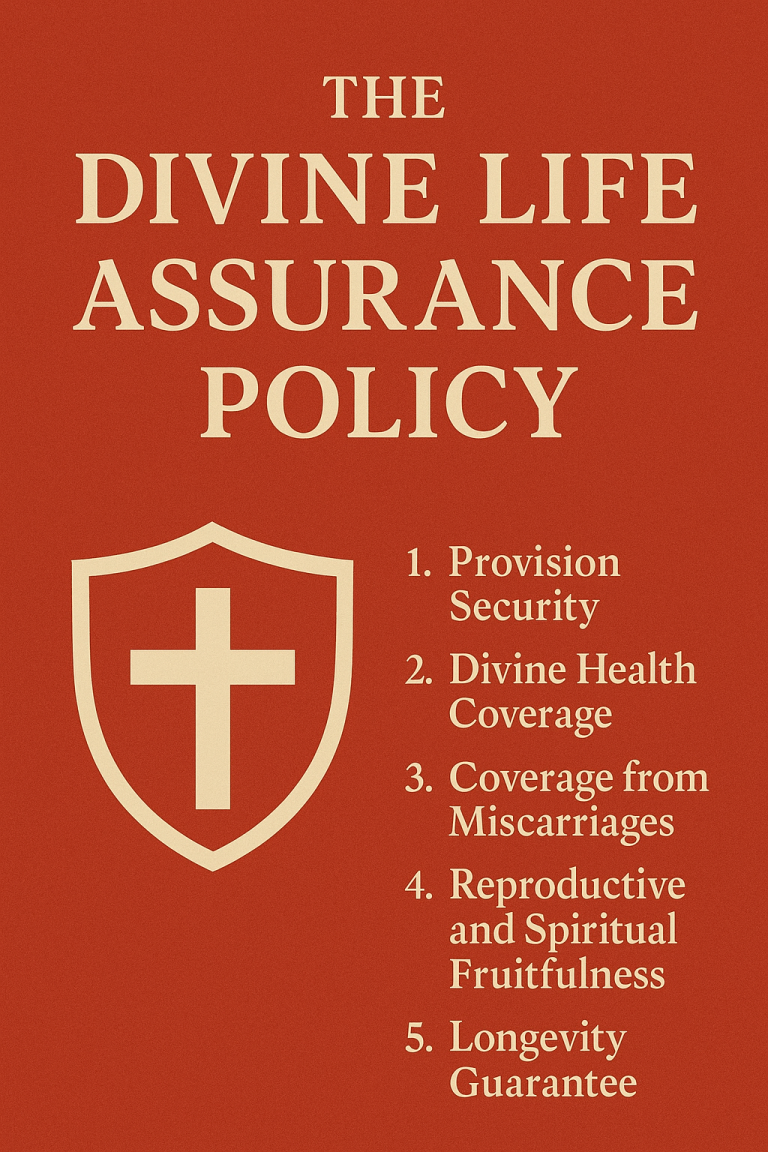
The Divine Life Assurance Policy
A few years ago, while finalizing some property transactions with my broker, she posed a question that stopped me in my tracks: “What would you do if you were suddenly unable to work or earn a living due to one critical health issue or another?” The African blood in me almost stopped her right there and then to say God forbid and / or back to sender! I mean, it was triggering, at least to me, we don’t speak like that around here – hahaha!
As the primary breadwinner for several dependents, the weight of that question stirred a moment of deep anxiety. Sensing the impact, she moved seamlessly into offering a range of insurance packages. But something she said stood out: most life insurance policies only pay out upon the death of the policyholder. In other words, the policyholder never gets to benefit from what they spent years paying into. At best, it's designed for those left behind.
It was in that reflective moment that the Holy Spirit brought to my heart a far greater, eternal perspective: God offers a better plan, a Divine Life Assurance Policy. Unlike worldly systems, this one is available in the Kingdom of God for those who commit to service and obedience. It’s what I call The Divine Life Assurance Policy.
A Heavenly Policy with Unmatched Guarantees
Look at it this way, in the natural world, life assurance provides financial protection. In God’s Kingdom, divine assurance provides total life security, physically, spiritually, emotionally, and eternally. What a wholistic coverage. This spiritual policy is laid out powerfully in Exodus 23:25–26:
“And ye shall serve the Lord your God, and he shall bless thy bread, and thy water; and I will take sickness away from the midst of thee. There shall nothing cast their young, nor be barren, in thy land: the number of thy days I will fulfil.
Here, God outlines five remarkable benefits that accrue to you and here, the beautiful thing about God's policy is that you can enjoy the benefits yourself whilst alive as opposed to just paying out to your dependents when you are no longer here:
1. Provision Security
“He shall bless thy bread and thy water.” – This means, you won’t lack or live in insufficiency. Your daily needs are covered. We see also in Matthew 6:33: “But seek ye first the kingdom of God... and all these things shall be added unto you.” As a matter of fact, this coverage ensures that you’d never be stranded as insinuated by my broker in the story I shared earlier. The Word assures us in Psalm 34:10 – “The young lions do lack and suffer hunger: but they that seek the Lord shall not want any good thing.”
2. Divine Health Coverage
“I will take sickness away from the midst of thee.” - God offers immunity, healing, and supernatural health. Psalm 91:10 is also very clear on this: “There shall no evil befall thee, neither shall any plague come nigh thy dwelling.”
3. Coverage from Miscarriages
“Nothing shall cast their young” – In this instance, the Divine Life Assurance Coverage ensures that you do not miscarry (in this context, this could mean a real foetus, your dream, aspiration or even your destiny). No wasted effort, rather, you’d have the grace to carry a baby to full term, complete your ministry and calling, start and complete projects and most importantly fulfil your destiny. Philippians 1:6 assures us thusly: “being confident of this very thing, that He who hath begun a good work in you will perform it until the Day of Jesus Christ.”
4. Reproductive and Spiritual Fruitfulness
“Nothing shall cast their young, nor be barren.” – The Divine Life Assurance Coverage also ensures that you are never barren in any area of your life (in this context, this could mean physical fruitfulness, career fruitfulness, relational fruitfulness, mental fruitfulness and what have you). You’d experience fruitfulness in all areas of life. Isaiah 54:1 corroborates this truth thusly: “More are the children of the desolate than of the married wife, saith the LORD.”
5. Longevity Guarantee
“The number of thy days I will fulfil.” – This means that your life won’t be cut short; you will fulfill your divine destiny and live to the fullness of your life here on earth. In Psalm 91:16, God further assures you: “With long life will I satisfy him...”
You'd see that the extent of the Divine Life Assurance package is unmatchable. I mean, as competitive as most insurance packages claim to be these days, non can offer guarantee on stable health, coverage from miscarriage, assurance of fruitfulness and most of all, assurance / guarantee on longevity. Only the Divine Life Assurance Policy can give you coverage for these inevitable life issues.
The Premium: Active Kingdom Service
Like every policy, this one also requires a premium, not of money, but of commitment and continuous kingdom service. As clearly seen in the introductory text of Exodus 23:25 “And ye shall serve the Lord your God”, the prerequisite to enjoy the Divine Life Assurance Policy is that you serve the Lord your God. The benefits of God’s Divine Life Assurance are not randomly distributed; they are reserved for those who have truly enlisted in kingdom service.
Many believers hope for divine rewards while remaining spiritually inactive, but this is a misunderstanding of how the Kingdom operates. You cannot enjoy benefits (salary, health benefits, or retirement plan) from an organization you don’t work for. The same principle applies in your walk with God. One thing I know from personal experience is that God keeps an account, and those who invest consistently in His kingdom are the ones who can draw from it in times of need. This divine accounting is echoed powerfully in Malachi 3:17–18:
“And they shall be mine, saith the Lord of hosts, in that day when I make up my jewels; and I will spare them, as a man spareth his own son that serveth him. Then shall ye return, and discern between the righteous and the wicked, between him that serveth God and him that serveth him not.”
God Himself draws a clear line between those who serve Him and those who do not. He calls His faithful ones His jewels, precious, protected, and personally valued. He promises divine exemption, saying He will spare them as a father spares a devoted son. This reveals the deeply personal nature of God’s Divine Life Assurance system.
Kingdom service is the premium that keeps the Divine Assurance Policy active. Without this daily engagement, the benefits remain theoretical. But for those who serve, God’s favor is not only guaranteed, it is distinguishing. Whilst the world offers its own reward system, glamorous but ultimately hollow, God’s policy offers something even more solid and eternal. If you want the full benefits of God’s divine life policy, you must fully align with Him. Half-hearted service yields no heavenly dividends.
Final Charge: Commit to the Policy, Reap the Rewards
God’s divine assurance plan is real, and it’s available to every believer who signs up through service, obedience, and devotion. The benefits are eternal and comprehensive. As seen in 2 Timothy 2:6-7: “The husbandman that laboureth must be first partaker of the fruits... and the Lord give thee understanding in all things.”
So, ask yourself today: Have you secured your divine life assurance policy? Are your premiums up to date through active service and faithful stewardship?
May your commitment be steadfast and may the rewards of kingdom service locate and distinguish you in Jesus’ name. Amen.
Author: Loveth Okocha
The Blood of Jesus Christ: God's Last Card - It was enough then, it is enough now!!!!
As we reflect on the death, burial, and resurrection of Jesus Christ this Easter, we are reminded: the Blood is not just a historical symbol, it is Heaven’s last card. God’s final and most potent move in the redemption story of mankind.
The Final Move
As a child, I remember playing card games with friends, each of us carefully guarding that one card we believed could turn the tide. There was always a dramatic moment when someone, confident of victory, slammed their final card on the table, their ultimate play, their unbeatable hand. In many ways, the blood of Jesus is God’s final card. When all else fails, when darkness seems to win, when hope feels lost God plays His most powerful move: the Blood of His Son. It’s not just a symbol or a doctrine. It is the declaration that the victory is already won.
Heaven’s Vengeance and Exemption
In Exodus 11:1, God speaks to Moses: “Yet will I bring one plague more upon Pharaoh, and upon Egypt; afterwards he will let you go hence…” We see from this scripture that the Blood was not just another plague, neither was it just another sign. This was divine vengeance, the judgment that would force Pharaoh's hand. When all else failed, frogs, lice, and darkness, God played His last card: the Blood.
In Exodus 12:13, God declared: “…When I see the blood, I will pass over you, and the plague shall not be upon you to destroy you…” That night, while the Egyptians wept and mourned from the impact of loosing all their first born-offsprings, the children of God, those under the Blood rejoiced. The Blood marked the line between judgment and mercy, death and life. It still does today and we must take all diligence to learn how to apply the Blood.
What the Blood Does
The Blood of Jesus is not just sacred, it is strategic. It speaks. It avenges. It heals. It redeems. It justifies. It empowers.
- The Blood is God’s vengeance – Exodus 11:1
- The Blood is our exemption – Exodus 12:13
- The Blood is our redemption – Ephesians 1:7
- “In whom we have redemption through His blood, the forgiveness of sins…”
- The Blood speaks better things – Hebrews 12:24
- “…the blood of sprinkling, that speaketh better things than that of Abel.”
- The Blood heals – Isaiah 53:5 - “…with His stripes we are healed.”
- The Blood justifies – Romans 5:9 - “Being now justified by His blood…”
- The Blood gives life – John 6:53 - “…Except ye eat the flesh… and drink His blood, ye have no life in you.”
- The Blood empowers victory – Revelation 12:11 - “They overcame him by the blood of the Lamb…”
- The Blood gives boldness – Hebrews 10:19 - “…boldness to enter into the holiest by the blood of Jesus.”
Once and For All
Hebrews 9:12 tells us: “Neither by the blood of goats and calves, but by His own blood He entered in once into the holy place, having obtained eternal redemption for us.” Jesus entered once for all through His own Blood. He didn’t just make a way; He became the way. Because of His sacrifice, we have access not just to forgiveness, but to fellowship with God Himself. The veil is torn. The door is open.
The Garden Before the Cross
Even before the Cross, the Blood began to speak. Luke 22:44 says: “…His sweat was as it were great drops of blood falling down to the ground.” In Gethsemane, drenched in sorrow, Jesus submitted to the will of the Father. The Blood began to flow there, not from wounds, but from obedience. It began to fight for our peace even before the first nail.
Action Steps- This Easter, Plead the Blood
- When Pharaoh won’t let go, show him the Blood.
- When the adversary won’t budge, apply the Blood.
- When affliction persists, plead the Blood.
God’s last card is still in play. It still avails. It still speaks. The Blood of Jesus is the final word over every matter. It was enough then. It is enough now.
Closing Prayer
Father, we thank You for the Blood of Jesus, Your final and flawless move in the redemption of mankind. We acknowledge its power, its voice, its eternal victory. Thank You that through the Blood we are healed, forgiven, justified, and made bold. Thank You that when all else fails, the Blood does not. Teach us to honor it, to trust in it, to walk boldly in the access it has granted. And this Easter, let the Blood speak over every dead thing in our lives let it declare resurrection, freedom, and victory.
In Jesus' name, Amen.
Author: Loveth Okocha

Stepping into Your Inheritance in Christ
Obadiah 1:17 (NIV) – “But on Mount Zion will be deliverance; it will be holy, and Jacob will possess his inheritance.”
As children of God, we have a divine inheritance—blessings, breakthroughs, and spiritual authority that Christ has purchased for us. However, many believers live beneath their God-given privileges because they have yet to step fully into what the Lord has prepared for them. Obadiah 1:17 outlines a threefold process for stepping into our inheritance: Deliverance, Holiness, and Possession.
1. There Shall Be Deliverance
Before we can walk in our inheritance, we must first experience deliverance. Many of us have faced struggles—be it financial hardship, sin, health issues, family crises, barrenness, or immigration challenges—that have held us back from experiencing the fullness of God’s promises. But the Word of God assures us that “on Mount Zion will be deliverance.”
Deliverance is God’s way of setting His people free from the chains of the enemy. In Luke 4:18, Jesus declared:
“The Spirit of the Lord is upon me, because he has anointed me to proclaim good news to the poor. He has sent me to proclaim freedom for the prisoners and recovery of sight for the blind, to set the oppressed free.”
If you are battling with sin, addiction, or cycles of failure, the power of Jesus is available to break every chain. Call upon the Lord and receive your deliverance today:
“So if the Son sets you free, you will be free indeed.” (John 8:36)
Practical Example:
A young woman who struggled with repeated job rejections prayed earnestly for God’s intervention. One day, she fasted and claimed Obadiah 1:17 in faith. Within weeks, she received a job offer that exceeded her expectations. Her deliverance had come!
Prayer: In the name of Jesus, I receive deliverance from everything that has held me captive. Every chain of oppression, financial struggle, sin, or delay in my life is broken today!
2. There Shall Be Holiness
Deliverance is only the beginning. To retain the blessings of God, we must walk in holiness. The Bible makes it clear that without holiness, no one will see the Lord (Hebrews 12:14).
In Romans 1:4, Jesus was declared the Son of God in power “according to the Spirit of holiness.” This same Spirit of holiness empowers us to live righteously and honor God in our daily lives.
Holiness is not about legalism or striving in our own strength—it is about surrendering to the Holy Spirit and allowing Him to transform us from within. The more we walk in holiness, the more we align ourselves with God’s will, making us vessels for His glory.
Practical Example:
A businessman who had struggled for years with dishonest dealings repented and chose to honor God in his transactions. Though it seemed difficult at first, God opened doors for him in ways he never imagined. By walking in holiness, he positioned himself to receive his full inheritance.
Prayer: Lord, I receive the Spirit of holiness. Give me the grace to live a life that pleases You. Let my life reflect Your righteousness and purity.
3. Possess Your Inheritance
Once you have been delivered and walk in holiness, it is time to possess your inheritance. Many believers have unclaimed blessings because they have not taken steps of faith to receive what God has already provided.
Joshua 1:3 says:
“I will give you every place where you set your foot, as I promised Moses.”
God has already prepared your inheritance, but you must rise and take possession of it. Whether it is a breakthrough in your career, family, health, or ministry, it is time to step forward boldly and claim what is rightfully yours in Christ.
Practical Example:
A couple struggling with infertility stood on the promises of God and declared their inheritance of fruitfulness. Despite medical reports, they continued to pray and trust in God’s Word. In due time, God blessed them with a child. They had possessed their possession!
Declaration: This week, I walk into my inheritance! God will make my life meaningful, and no one will say “no” to me again!
Final Encouragement
Your time to step into your inheritance has come. Deliverance has been granted, holiness has been imparted, and now it is time to take possession of what God has for you. Do not let fear, doubt, or the enemy’s lies stop you. Stand on the promises of Obadiah 1:17 and walk boldly into your destiny.
“Arise, shine, for your light has come, and the glory of the Lord rises upon you.” (Isaiah 60:1)
Go forth and possess your possessions!
Author: Loveth Okocha